Day 6: 112 Liters of Smelly Pee

Today was disgusting… all we did was transfer human urine from gallon milk jugs to graduated cylinders to giant containers so that the urine could be filtered and sterilized. Eventually we had transferred and poured 112 liters of pee from place to place. It was utterly gross. Personally, I thought the pee smelled like wet dog food; however, some of the donor’s pee smelled way worse than that. At least we could pass the time and get our minds off of the scent with jokes made by the lab workers. It was reassuring to know that the lab workers weren’t super serious about human urine and could be quite humorous about the subject. It was also very humorous when the lab manager spilled pee all over Jonathan’s lab coat on accident, which down his leg and into his shoe a bit. It was very funny how comfortable they all were dealing with human urine

Me pouring urine from a gallon jug to a 4 L graduated cylinder:

IMG_0996

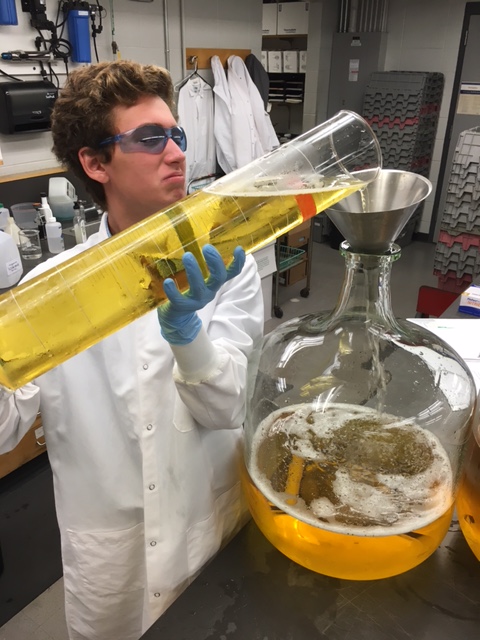
Jonathan pouring urine from the graduated cylinder into the big jug (it is evident from his face that he is not enjoying it):

IMG_0999

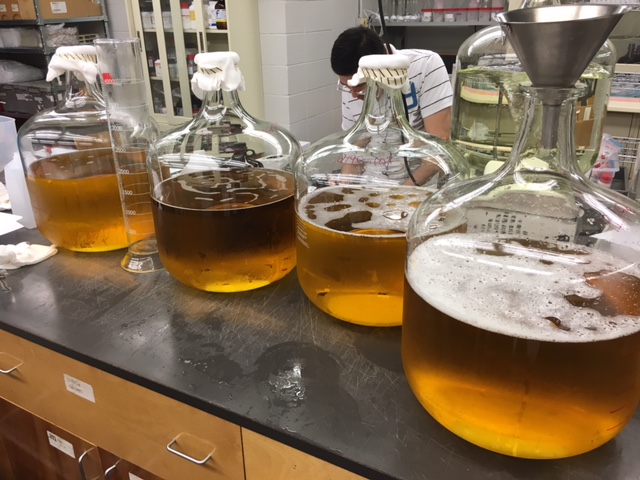
A total of 112 L of human urine:

IMG_1002

I wouldn’t consider today really fun or informative, but I guess it was cool to witness how the dirty work gets done, and how essential it actually is to forensics. I will definitely not take this kind of stuff for granted again! – Kiran W.

Day 5: Using Drugs at Work?

Today we our first day at RTI working with the forensic science department. We started the day with a brief presentation on “Mass Spectrometry”, which is using a machine to identify drugs by separating them out of a substance by analyzing the unknown drug compound using its known molecular mass. We then got a tour of the labs and were able to actually use a mass spectrometer to identify certain drugs. We were able to identify drugs such as cocaine and codeine.

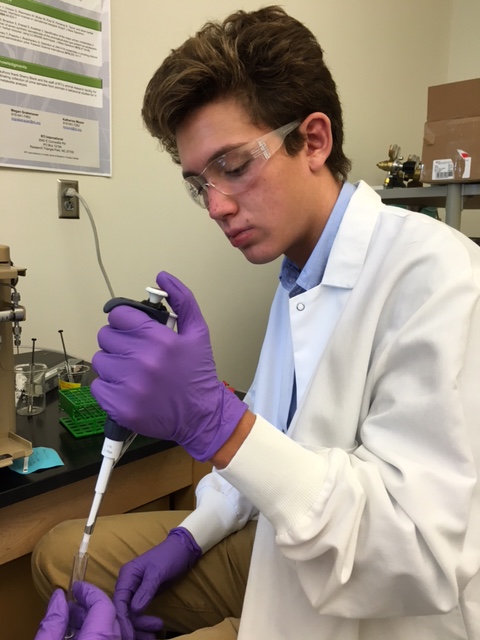
Jonathan pipetting a solution containing an unknown drug onto a transfer sheet to place into the mass spectrometer:

IMG_0966

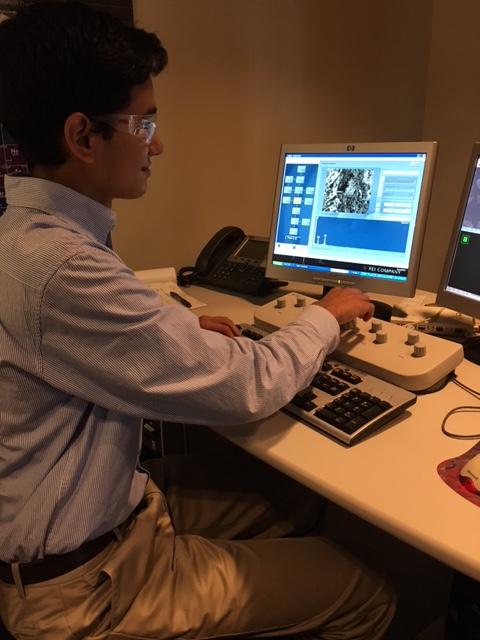
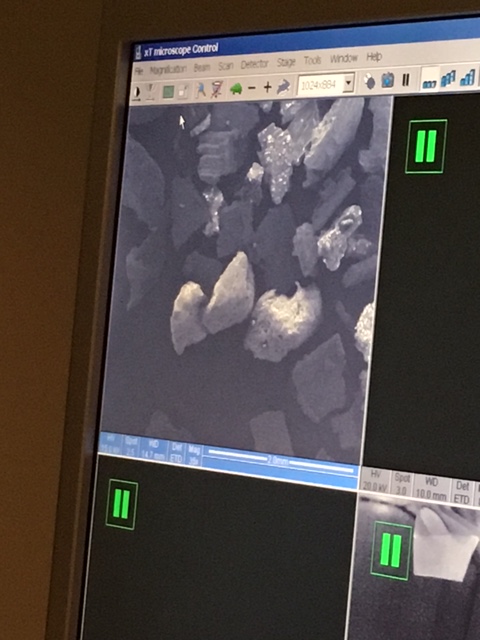
Then, we were able to go and use a very powerful microscope that was able to zoom in on individual molecules so that we could analyze their crystal lattice structures.

Me using the microscope to examine grains of salt (NaCl):

IMG_0959

The enlarged grains of salt on a computer screen:

IMG_0961

Overall today was a pretty interesting day and I got to learn some neat things about chemistry that I didn’t even learn in my ADV Chemistry class this year! – Kiran W.

Day 4: It made a lasting “impression” on us

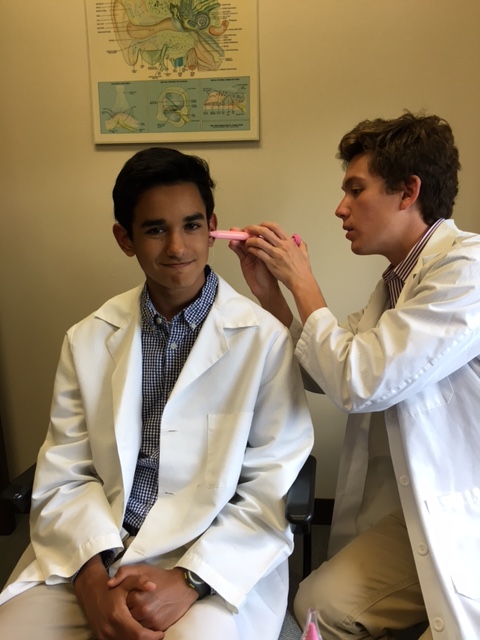
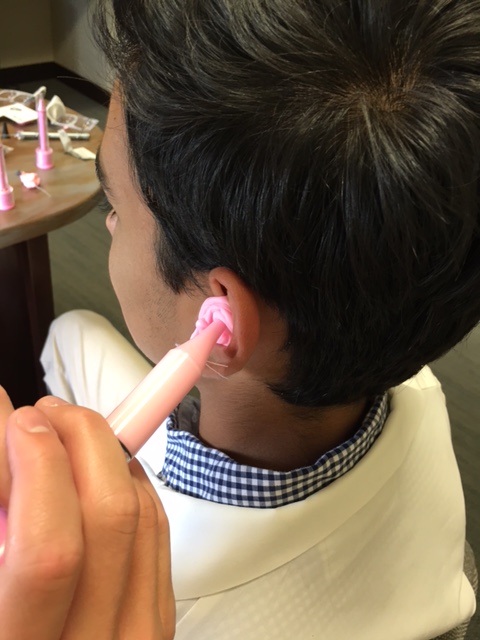
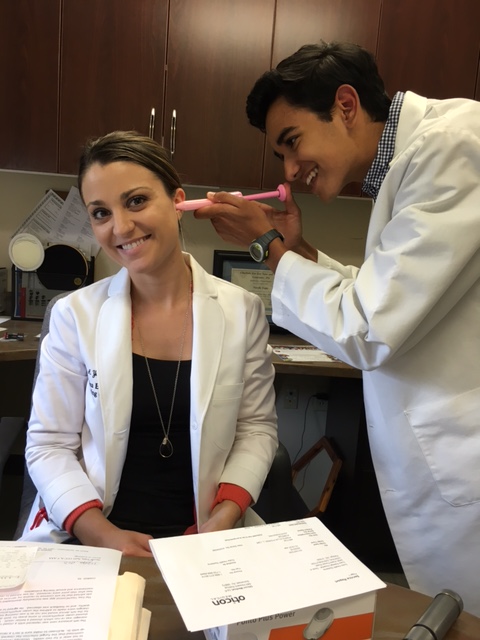
Today was a very interesting day because we got to learn about different patients’ backstories, and one backstory in particular amazed us. Referred to as Carolina Ear and Hearing Clinic’s most interesting patients (at least by us), this patient came in for her hearing aid upgrade to a newer model, and we learned a lot about her during her visit. She was born fairly deaf – so much so that the first time that she heard birds chirping was when she was 45 years old! Thus, when she was younger, learned how to speak fluent English without ever hearing her own voice! She also passed nursing school only by reading lips! Jonathan and I were amazed. This patient was a very cool person to have been able to meet. After this patient, it was time for our lunch break, and the staff surprised us with pizza to celebrate our last day at the clinic! It was really generous of them to do that, which made us even sadder to leave when the workday ended. Before we left however, we were able to play around with some of the impression substance that the audiologists put in people’s ears if they need to have a custom hearing aid built to fit their ear.

Nicolle, one of the audiologists, demonstrating how to fill y ear canal with the impression putty:

IMG_0944

Jonathan attempting to fill my other ear with the putty:

IMG_0950

My ear canal with the impression putty filling it:

IMG_0953

Me filling Nicolle’s ear with impression putty:

IMG_0955

At the end of the day we were really sad to leave the office as we had such an amazing week interning at Carolina Ear and Hearing Clinic. It was one of my most influential experiences up to date, and I am so grateful that we had this opportunity! – Kiran W.


Saying Goodbye (Last Day @AMM)

Today was my last day at Alliance Medical Ministry. Like yesterday, Dr. Lewis started seeing patients at 8:30 am. Today was a very busy day with some unexpected challenges .I can’t say anymore about the challenges because of doctor-patient confidentiality. However, I can mention that some of the things we discussed included glaucoma, celiac disease, anemia, hernias, and bariatric surgery. Dr. Lewis  was extremely willing to answer my questions about these topics. At around 12 pm Dr. Lewis was still seeing patients back to back but she allowed me to go on my lunch break anyway. By the time I finished lunch Dr. Lewis had already finished up with her last patient of the day. So for the remainder of my time at Alliance I stayed with Dr. Lewis as she made phone calls and  took notes on her patients. We even had a chance to chat a bit before I left the practice. Overall, I have had a fantastic time at AMM. Dr. Lewis was the perfect doctor to shadow as she truly cares about her patients and goes above and beyond to give them the best care possible. Both her patients and the nurses I’ve spoken to speak very highly of her. Not only has she been a great teacher, but she’s also encouraged me and given me advice. I’m confident that I will keep in touch with Dr. Lewis well after this work experience program. AMM pic 3

Pictured above are my parting gifts from Dr. Lewis ❤ 

-Biruk

Day 3: Check 1, 2, 3

Waking up today was glorious, because we had an extra two hours of sleep which begun the day strong. Nothing was scheduled until around 9 o’clock, so the doctors didn’t need us at the hospital until then.

When we arrived a doctor named Leah told us that we could try hearing tests on each other and experience what patients experience at the hospital. I had never gotten my hearing checked before so it was all very new to me. We entered a soundproof room and begun checking each others ears like we’d seen Dr. McElveen do several times. Once everything was set, we begun the testing. Kiran left the room and I put on a set of over-ear headphones. He began emitting a sound at 1,000 hz, and tested to see when the lowest db I could hear it at. After 10-20 minutes of various frequencies we switched and I began testing him. The machine to test was complicated and it took a while to get used to it. I managed to successfully test his hearing and we both recorded the results. Shockingly, his hearing was perfect and mine was only slightly under perfect, so you can image what the rest of the day was like for me. It was fairly unclear who had better hearing after our first test, but we both scored in the normal hearing range. The second test was simply saying words through the microphone and the patient had to repeat the words back to the doctor.

Day 3b

If a patient scored in the profound hearing range, then they are candidates for cochlear implants which will grant you the ability to hear again, but at a cost. The reason that only certain patients are candidates for cochlear implants is because surgically implanting them will ultimately wipe out the rest of your hearing. Any time you don’t have the assisting aid on your ear you’re practically deaf, but on the brighter side as long as you have the implant your hearing will sky rocket. How the implant works, is the surgeon cuts near the patient’s temporal bone and inserts a small mechanism right near the ear. Two long strands connected to the device are implanted in the cochlea and a small magnet is implanted behind the ear. A device on the outside also contains a magnet, and is positioned so that the magnets connect through the skin. This device then sends twenty-two electrodes into the cochlea, which contains thousands of damaged electrodes, and grants the patient a limited amount of sounds their ear can process.

Day 3a

After the hearing test it was around noon which is our lunch break, but everyone seemed to be out that day so Kiran and I ate alone in the lunch room.

After lunch Kiran and I split up again and I sat with Kate in her office and she explained so much to me about diseases and cochlear implants. She showed me diagrams and hearing aids and gave me papers. We had a great conversation, which ended up lasting around two hours: the fastest two hours of my life. By that time it was around 3 or 3:30, so I headed back to my room and continued my work and read some of the papers Kate gave me. By the time I was done Kiran had come out of the room with Nicolle and we headed back home.

All in all it was a day of learning and growth.

Day 2: The Surge of Surgery

Today picked up tempo quickly and suddenly. We began by meeting Dr. McElveen at Duke Hopsital, and had difficulty finding the entrance to the Same-Day Surgery building. We arrived 10 minutes early, so he hadn’t arrived yet and we were instructed to ask another nurse in the back about his whereabouts. Each nurse directed us further and further in the building and eventually we were in the middle of the building, surrounded by surgeries and doctors. Dr. McElveen laughed when he found us and led us through the labyrinth and towards the changing station. We put on scrubs and were thrown into a room where Dr. McElveen began surgery on a patient who suffered from damage towards the ear drum. I couldn’t quite tell whether or not it was cochlear implant surgery, but whatever it was was fascinating to me and Kiran. Ear surgery is far too cramped for me, it gives absolutely no room for error or else the patient could go deaf. All surgery is precise and requires steady hands, but there is nothing in accord with watching ear surgery. Dr. McElveen does the entire procedure under a microscope, which Kiran and I tried afterwards on a temporal bone. Carolina Ear & Hearing Clinic has one of the two temporal bone labs in the country, and Kiran and I were given the chance to mimic Dr. McElveen’s surgery procedure. We were given microscopes and tools to understand how difficult it is to do surgery under a microscope with such limited movement.Scrubs.jpg

Afterwards Dr. McElveen had to go to South Carolina so Kiran and I were sent back to the hospital to resume our experience. We were assigned a paper on Stapedectomy’s and Otosclerosis, and we learned what the procedure is for dealing with it. Otosclerosis is the buildup of bone tissue in the outer ear around the stapes. This prevents the stapes from transmitting sound energy to the inner ear, causing the victim to suffer from either conductive or mixed hearing loss. Stapedetomy is the procedure done to continue the flow from the outer ear to the inner ear. The surgeon does an incision on the two arms of the stapes and cuts a whole in the stapedotomy which is a wall connected to the stapes. A piston-like object, called the prosthesis, is then connected to the incus is strung through the stapedotomy.

Dr. McElveen had to go to South Carolina for the rest of the week so Kiran and I split up and spent the rest of the day with separate doctors. I saw some interesting patients, some were impatient and curt white others were amiable. Nicolle, the doctor I was working with, knew all of the patients well because she’d spent so much time with them, and it was interesting seeing her interact with the ones she was fond of and the ones she wasn’t as fond of.

All in all I learned a lot about diseases in the ears and about how to deal with certain patients and how to be patient.

Day 1: What’s Up Doc?

Day 1 was an enriching experience with Dr. McElveen and his numerous patients. When Kiran and I arrived, we were nervous entering the enormous, winding office that the doctors worked in. We began with a staff meeting, where Dr. McElveen and his associates organized everyone’s schedule for the month. The staff worked well as a group, they were quite supportive and the staff meeting was a great way to observe everyone interact. During the meeting they celebrated the engagement of Kate, an associate, and commemorated John-Thomas Junior for the graduation of his children. Finally, the meeting was over and everyone split up into their own work spaces in the winding and confusing office.

Day 1.jpg

Next, Kate gave us a tour of the building and showed us where Kiran and I would set up our stuff for the week. We didn’t spend much time in there at all, though, we were often on our feet and participating in check-ups with patients. In fact, Kiran and I faced some adversity spending the entire day today on our feet, moving from room to room with Dr. McElveen and his patients and always standing in the corner, observing. It was fantastic listening to each patients story, every one of them had known Dr. McElveen personally, because he had worked with them for so many years.

We didn’t learn many logistical aspects of ear surgery or even the anatomy of the ear. We were taught that the ear consisted of three central bones, the malleus, the incus, and the stapes, but that was it for the most part. We watched Dr. McElveen remove a hearing aid from a patient under a microscope that was enhanced on a television screen in the corner, which was fascinating. Another patient was a young child who couldn’t work their hearing aid so that was interesting.

For the most part we focused on treating and handling patients today, and meeting the other doctors and learning about their individual specialties.

Day 3: Do You Hear What I Hear?

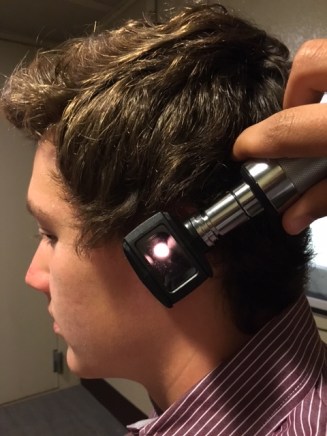
This morning was awesome because 1. Jonathan and I didn’t have to be at the office until 9:00 and 2. we got to learn how to operate the hearing test machines and conduct hearing tests on each other! First we examined each other’s ears with an otoscope to make sure that nothing was in the ear canal that would block sound from entering and reaching the ear drum, such as ear wax.

Me examining Jonathan’s ear canal with an otoscope:

IMG_0939

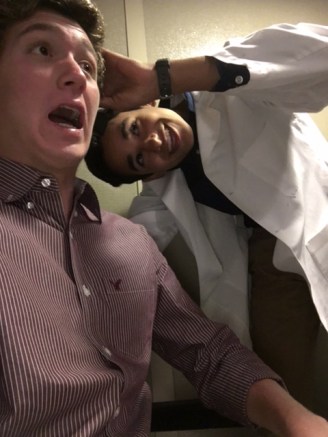
Jonathan goofing around while I looked into his ear canal:

IMG_0940

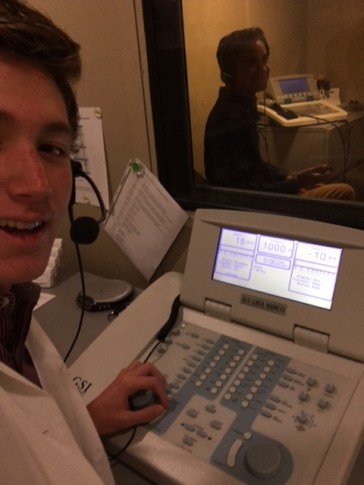
After we got the “all clear” from each other that our ear canals were clean, one of us headed to another room where the hearing test machine was located so that the “patient’s” room was completely silent and no sound would interfere with their hearing test. To conduct the hearing test, you start the sound at a certain frequency in only one ear, and change the amount of decibels each time. If the patient responds to a sound by pressing a button, you decrease the amount of decibels by 10. If the patient does not hear the sound, you increase the amount of decibels by 5 until the patient is consistently hearing a certain number of decibels at the one frequency. You chart this number and then change the frequency and start again until the chart is completed. After the chart is complete, you have the hearing test complete for the one ear, so you switch to the other ear and repeat.

Pausing during my hearing test for a quick selfie. In the picture the top left number is the decibel amount for the one ear (15 dB) and the middle number is the frequency (1000 Hz).:

IMG_0934

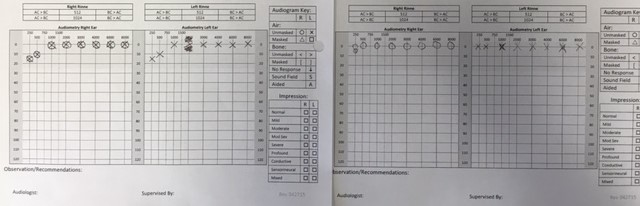
After our hearing tests, our charts determined that Jonathan had normal hearing; however, he couldn’t hear the lower frequency sounds when the decibel amount was too low, while I had perfect hearing and was able to hear all of the frequencies even at 0 decibels (subtle brag… Jonathan was a little jealous of this).

Our completed hearing charts. Jonathan’s hearing chart is the one on the left while mine is on the right. Patients who come in with hearing loss will typically have points that are more towards the middle of the chart.:

IMG_0932 (2)

After our hearing tests, we had our lunch break followed by some routine hearing aid checkups. Many of the patients that the audiologist and I saw were participating in a study with a new type of hearing aid that sends a laser light down the ear canal that hits a light receptor on what was described as “a contact lens for the ear drum” which causes a motor to vibrate the ear drum and allows that patient to hear. This new technology is very advanced and groundbreaking.

Overall today was a very fun and informative day as we learned about a lot about the technology that audiologists use in the current day and age. I especially enjoyed being able to conduct the hearing test on Jonathan, and the audiologists told us that tomorrow we would be able to do more experiments on each other using different types of technology. I can’t wait! – Kiran W.

I’m Back & I’m Better (Day 3 @AMM)

Today has been the busiest day yet. Dr. Lewis started seeing patients at 8:30 am and I followed her as she went about her day. Dr. Lewis encourages me to ask questions (I’ve had many!) and does not hesitate to answer them. Today our discussions included tuberculosis, the difference between a CT scan and a MRI, interferons, hepatitis, and much more. Then, I had about an hour for a lunch break. Before I had lunch, I stopped by Ms. Daniel’s office to see if she needed anything. There were some patient packets that needed to be made so I worked on putting the packets together after I ate. When the lunch break ended, I met up with Dr. Lewis and continued shadowing her until 3:30 pm. Today was a longer day than the first two, but it was no less interesting, enjoyable, or educational.
-Biruk


Day 2: We’re No Longer Scrubs!

Today might just have been the coolest day that I’ve ever experienced up to date. Jonathan and I didn’t actually start the day at Carolina Ear and Hearing Clinic though; instead we woke up at 6:00 to shadow Dr. McElveen in an operating room at Duke Raleigh Hospital. When we arrived, we scrubbed up and received our official name tags to then follow Dr. McElveen to an operating room where he would preform a tympanoplasty operation.
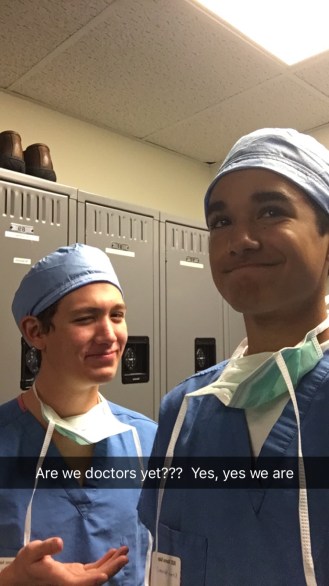
IMG_0904

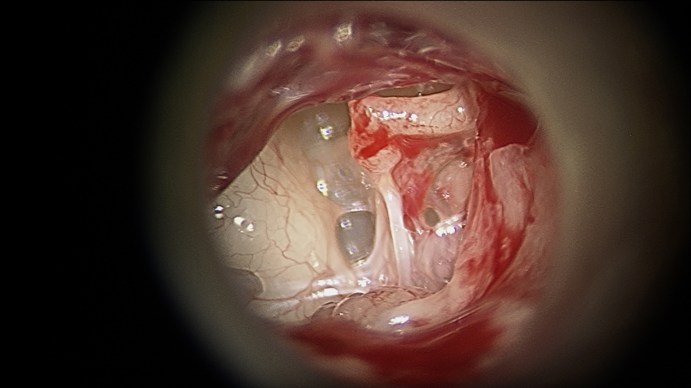
In the operating room, Dr. McElveen explained to us that the patient’s ear drum had collapsed when her Eustachian tube (a passage that permits the equalization of pressure on both sides of the ear drum) acted as a vacuum and sucked the ear drum in on itself. The collapse caused a tear in the ear drum, so the patient had a large hole in it. To correct this, Dr. McElveen cut cartilage away from the back of the patient’s ear and augmented it to her ear drum to patch up the hole.

The “middle  ear” of the patient during surgery, showing the stapes and incus bones as well as the folded-back tympanic membrane:
Surgery1

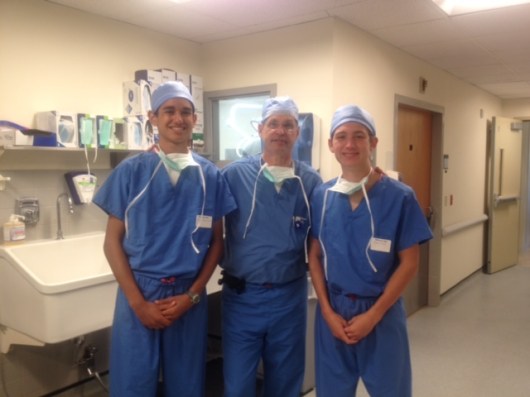
After the successful surgery ended, we celebrated with some pictures with Dr. McElveen and in our scrubs:
IMG_0929

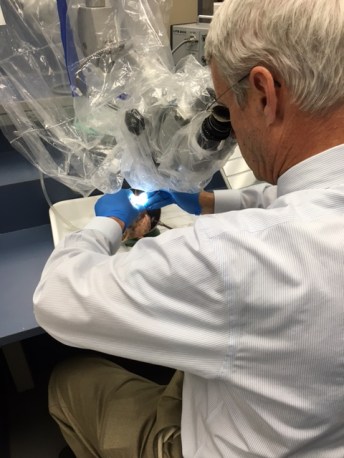
We then headed back to the Carolina Ear and Hearing Clinic where Dr. McElveen set Jonathan and me up in the clinic’s temporal bone lab. He let us probe a temporal bone and it’s ear cartilage, and it was really cool! However, we did find out how hard it is to actually be a surgeon from this because of how precise your instruments need to be held, and how hard it is to keep your hands from shaking when probing the patient’s body. The ear canal is so narrow that I felt like I was playing Operation since I wasn’t supposed to shake the probe and touch the sides of the canal!

Dr. McElveen demonstrating how to probe the temporal bone in the bone lab:
IMG_0908

Jonathan probing the temporal bone:

IMG_0909

After we (half) successfully probed the temporal bone and the ear cartilage, we had our lunch break. After lunch, Dr. McElveen had to leave to go to South Carolina to perform a surgery there. Thus, Jonathan and I separated and I went with one of the audiologists to examine a patient with a tumor on their hearing nerve called an acoustic nueroma. She conducted several tests on the patient in order to determine whether it was worth it for Dr. McElveen to attempt to save the patient’s hearing capability in the ear and remove the tumor, or if he should just incise the hearing nerve in order to remove the tumor, which would ultimately render the patient deaf in the one ear. One of the tests was to lay the patient down in a dark room and put plugs in her ears that would send sounds through her nerves and a machine would measure how long it took the brain to receive the sound. The patient had to lay completely still so that all of the body’s focus would be on delivering those sounds to her brain. Apparently she was laying so still that she actually fell asleep during the test! This was okay though according to the audiologist because the data still comes back accurately. After several tests, the audiologist determined that it would not be worth it for Dr. McElveen to attempt to save the patient’s hearing capability.

Today was such an amazing experience since we did so much observing and hands-on activities! I will never forget being in that operating room and observing the surgery; my jaw was dropped the whole time as I was in such awe of what Dr. McElveen was doing throughout the operation! It was also a very formative experience, and it definitely sparked my interest in possibly going into surgery as a career option. – Kiran W.