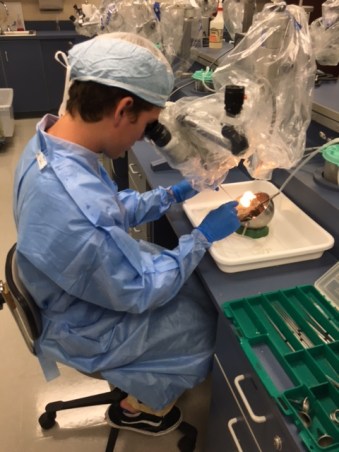
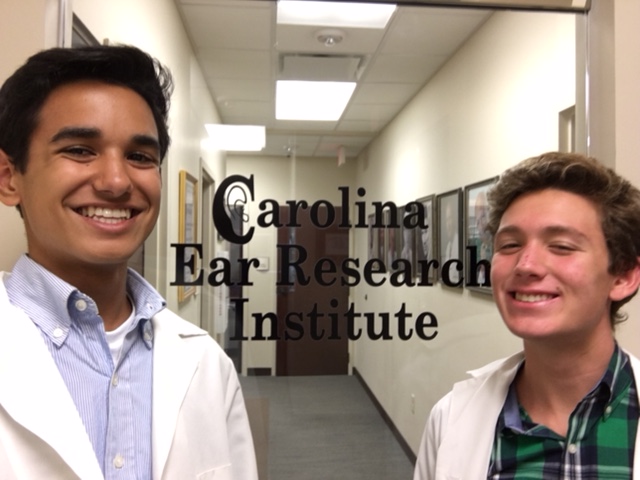
Day 8: Wish We Could Turn Back Time…

…But now we’re stressed out! That’s right, today we were able to play with really cool smart devices that allowed us to track certain responses of the body including stress levels! We actually met our mentor for today, Robert, yesterday when he came in to hook us up to a smartwatch when we were experimenting with the virtual reality “Oculus Rift” technology. This was his first experiment recording the body’s response to a person being submerged into virtual reality, and the data that was collected was very surprising and cool!

Me using the “Oculus Rift” virtual reality headset with my body’s response to being in the virtual reality state:

KTW

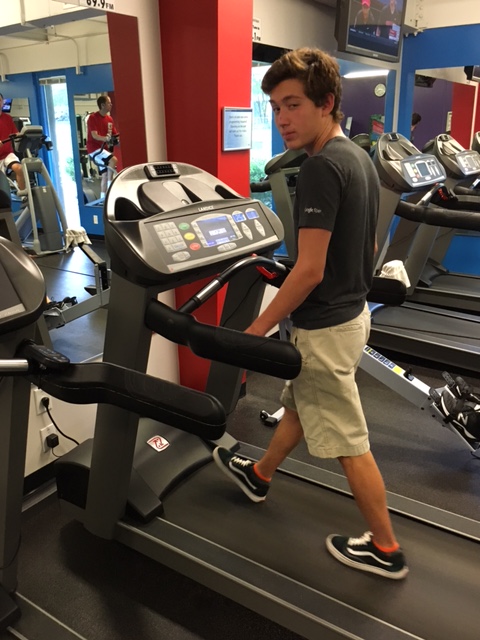
In the graph above, the blue line indicates my stress level, which is shown to be steadily and constantly increasing. This stress level had the same increasing tendency for all three of us interns, which shows that virtual reality may not be healthy for the body if it constantly increases our stress levels the longer that we are in it. This experiment is prompting Robert to continue analyzing stress levels for people who are submerged into virtual reality, and he considers this new knowledge to be revolutionary! Can you believe that we were the guinea pigs for revolutionary knowledge?! After learning about stress in the human body, we were suited up with complimentary fitbit zips that we got to keep! With the fitbit zip we tracked the accuracy of number of steps taken using the fitbit, apple watch, and “Moves” app. We walked on a treadmill for 5 minutes while all of the devices were counting and while someone else counted the actual number of steps we took. We found that the fitbit was the most reliable source because the number pf steps that it counted were closest to the number of actual steps.

Jonathan on the treadmill with his devices counting the number of steps he took:
IMG_1036

Then, just for fun (and for science :)), we decided we should try to cheat the fitbit and rack up as many steps as we could. For our first experiment we taped the fitbit onto a drill bit, and turned the drill on. Surprisingly, all of the quick rotations that the fitbit made did not contribute to a large number of steps taken. Then, for our second experiment, we duct taped the fitbit to the wheel of Robert’s car and we observed how many steps were recorded as Robert drove around. The fitbit racked up some steps, but not as much as expected. I guess if you want steps you have to actually exercise!

The fitbit duct taped to the wheel of Robert’s car:

IMG_1045

Today was a really fun day since we got to come up with our own experiments and execute them! We also learned that we may have revolutionized virtual reality, so that was cool! Overall it was a really great way to end our internship at RTI, although it was also sad to say goodbye to the Work Experience Program. For me this program has been a huge success, and I hope it continues being implemented and offered to Cary Academy students in future years! – Kiran W.

Day 7: The New Reality is Virtual Reality

Today we were able to experience virtual reality! Caroline, a student from Cardinal Gibbons, also joined us today for our internship.We started off by learning about the history of virtual reality and seeing the project that John, our mentor today, was working on. He was trying to build a simulation for forensic scientists to be able to learn how to use a certain machine that would separate strands of DNA by length. We then sat in on a meeting with some very prolific people in the field of forensics from Texas where John showcased his project.

Us in the conference room for the meeting (Caroline is in the middle):

IMG_1005

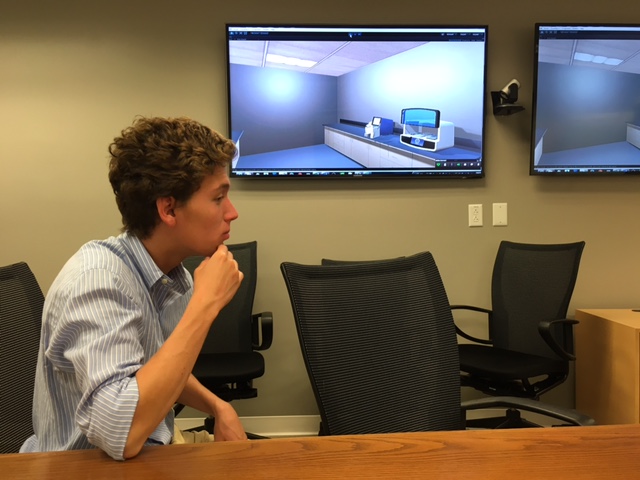
Jonathan observing the meeting with the project project behind him:

IMG_1007

Then, we got to go experiment with the “Oculus Rift” Virtual Reality technology which was really cool. We were able to actually build a virtual world by creating blocks and moving them. It was awesome technology that we learned will soon be implemented into normal life and homes everywhere. Types of virtual reality devices are already available to the public such as “Google Cardboard”.

Jonathan with the “Oculus Rift” headset on his head, and him creating blocks in the virtual world:

IMG_1016

A video of me using the “Oculus Rift” headset:

Being able to use the virtual reality technology was a great experience, and I hope it becomes popularized enough that we start to see more of it out in the real world soon! – Kiran W.


Day 6: 112 Liters of Smelly Pee

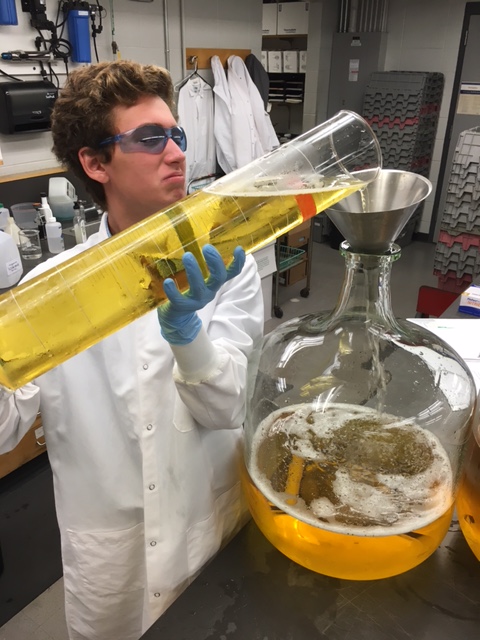
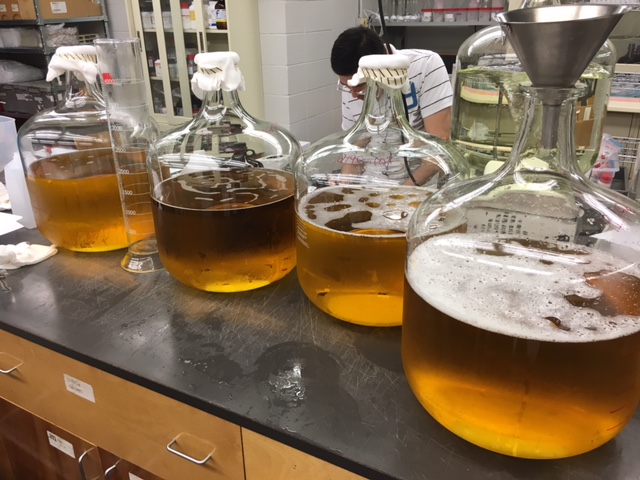
Today was disgusting… all we did was transfer human urine from gallon milk jugs to graduated cylinders to giant containers so that the urine could be filtered and sterilized. Eventually we had transferred and poured 112 liters of pee from place to place. It was utterly gross. Personally, I thought the pee smelled like wet dog food; however, some of the donor’s pee smelled way worse than that. At least we could pass the time and get our minds off of the scent with jokes made by the lab workers. It was reassuring to know that the lab workers weren’t super serious about human urine and could be quite humorous about the subject. It was also very humorous when the lab manager spilled pee all over Jonathan’s lab coat on accident, which down his leg and into his shoe a bit. It was very funny how comfortable they all were dealing with human urine

Me pouring urine from a gallon jug to a 4 L graduated cylinder:

IMG_0996

Jonathan pouring urine from the graduated cylinder into the big jug (it is evident from his face that he is not enjoying it):

IMG_0999

A total of 112 L of human urine:

IMG_1002

I wouldn’t consider today really fun or informative, but I guess it was cool to witness how the dirty work gets done, and how essential it actually is to forensics. I will definitely not take this kind of stuff for granted again! – Kiran W.

Day 5: Using Drugs at Work?

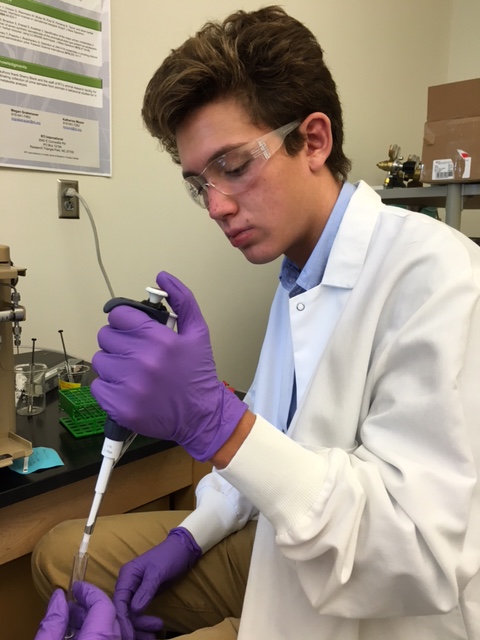
Today we our first day at RTI working with the forensic science department. We started the day with a brief presentation on “Mass Spectrometry”, which is using a machine to identify drugs by separating them out of a substance by analyzing the unknown drug compound using its known molecular mass. We then got a tour of the labs and were able to actually use a mass spectrometer to identify certain drugs. We were able to identify drugs such as cocaine and codeine.

Jonathan pipetting a solution containing an unknown drug onto a transfer sheet to place into the mass spectrometer:

IMG_0966

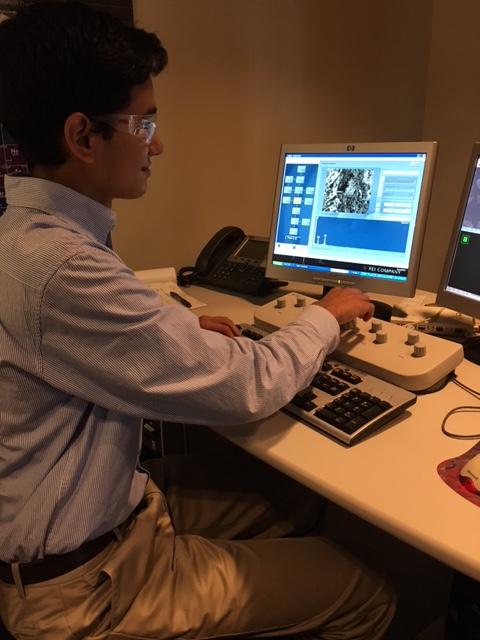
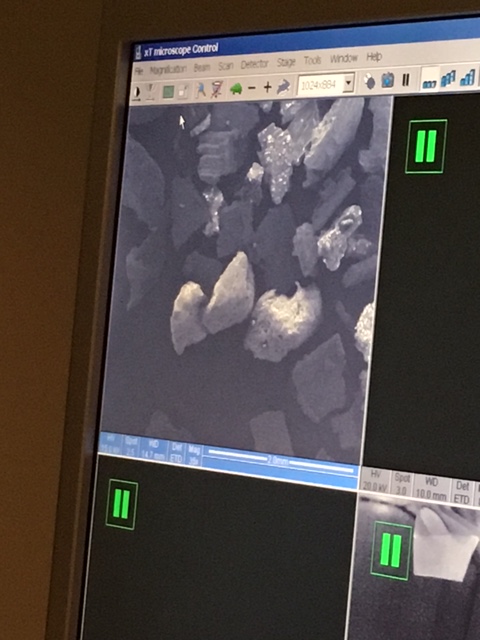
Then, we were able to go and use a very powerful microscope that was able to zoom in on individual molecules so that we could analyze their crystal lattice structures.

Me using the microscope to examine grains of salt (NaCl):

IMG_0959

The enlarged grains of salt on a computer screen:

IMG_0961

Overall today was a pretty interesting day and I got to learn some neat things about chemistry that I didn’t even learn in my ADV Chemistry class this year! – Kiran W.

Day 4: It made a lasting “impression” on us

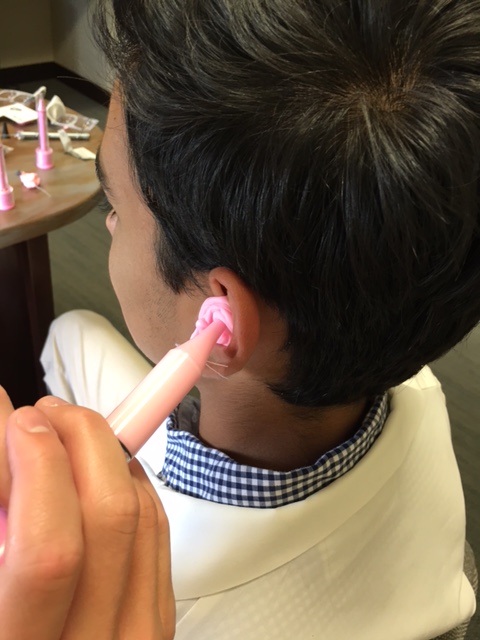
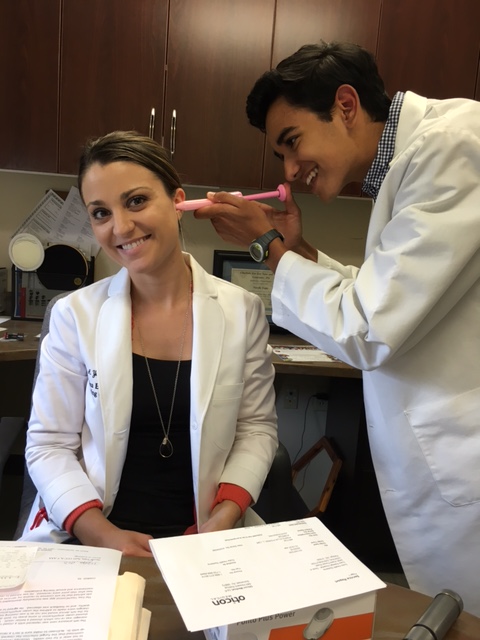
Today was a very interesting day because we got to learn about different patients’ backstories, and one backstory in particular amazed us. Referred to as Carolina Ear and Hearing Clinic’s most interesting patients (at least by us), this patient came in for her hearing aid upgrade to a newer model, and we learned a lot about her during her visit. She was born fairly deaf – so much so that the first time that she heard birds chirping was when she was 45 years old! Thus, when she was younger, learned how to speak fluent English without ever hearing her own voice! She also passed nursing school only by reading lips! Jonathan and I were amazed. This patient was a very cool person to have been able to meet. After this patient, it was time for our lunch break, and the staff surprised us with pizza to celebrate our last day at the clinic! It was really generous of them to do that, which made us even sadder to leave when the workday ended. Before we left however, we were able to play around with some of the impression substance that the audiologists put in people’s ears if they need to have a custom hearing aid built to fit their ear.

Nicolle, one of the audiologists, demonstrating how to fill y ear canal with the impression putty:

IMG_0944

Jonathan attempting to fill my other ear with the putty:

IMG_0950

My ear canal with the impression putty filling it:

IMG_0953

Me filling Nicolle’s ear with impression putty:

IMG_0955

At the end of the day we were really sad to leave the office as we had such an amazing week interning at Carolina Ear and Hearing Clinic. It was one of my most influential experiences up to date, and I am so grateful that we had this opportunity! – Kiran W.


Day 3: Do You Hear What I Hear?

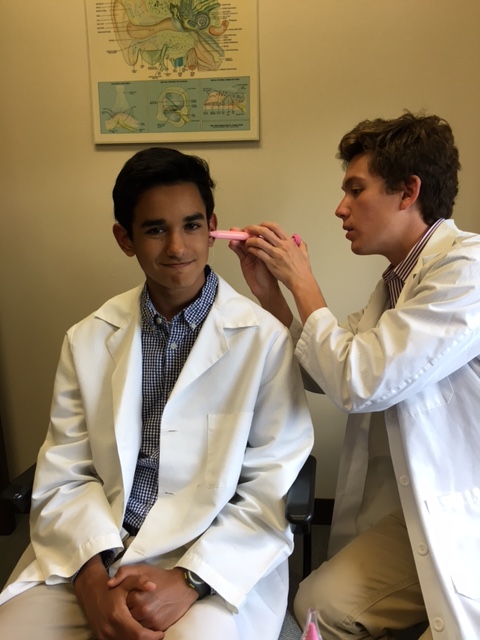
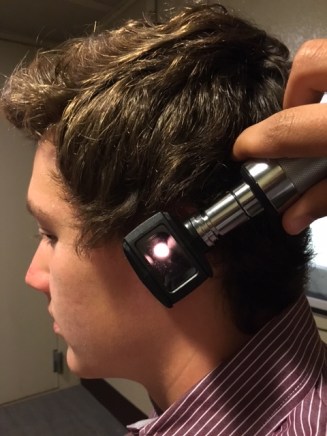
This morning was awesome because 1. Jonathan and I didn’t have to be at the office until 9:00 and 2. we got to learn how to operate the hearing test machines and conduct hearing tests on each other! First we examined each other’s ears with an otoscope to make sure that nothing was in the ear canal that would block sound from entering and reaching the ear drum, such as ear wax.

Me examining Jonathan’s ear canal with an otoscope:

IMG_0939

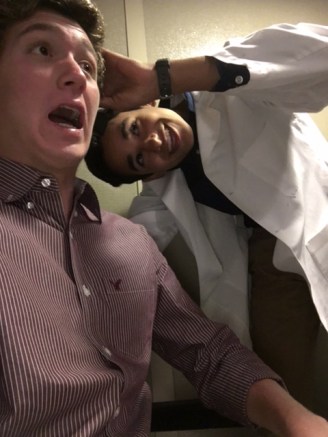
Jonathan goofing around while I looked into his ear canal:

IMG_0940

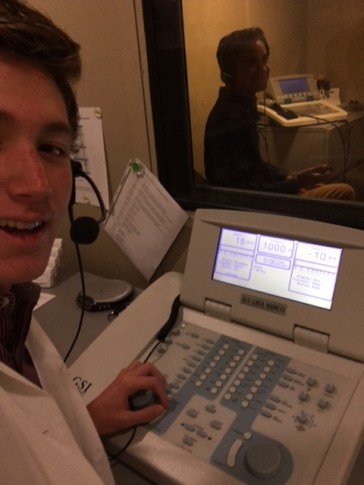
After we got the “all clear” from each other that our ear canals were clean, one of us headed to another room where the hearing test machine was located so that the “patient’s” room was completely silent and no sound would interfere with their hearing test. To conduct the hearing test, you start the sound at a certain frequency in only one ear, and change the amount of decibels each time. If the patient responds to a sound by pressing a button, you decrease the amount of decibels by 10. If the patient does not hear the sound, you increase the amount of decibels by 5 until the patient is consistently hearing a certain number of decibels at the one frequency. You chart this number and then change the frequency and start again until the chart is completed. After the chart is complete, you have the hearing test complete for the one ear, so you switch to the other ear and repeat.

Pausing during my hearing test for a quick selfie. In the picture the top left number is the decibel amount for the one ear (15 dB) and the middle number is the frequency (1000 Hz).:

IMG_0934

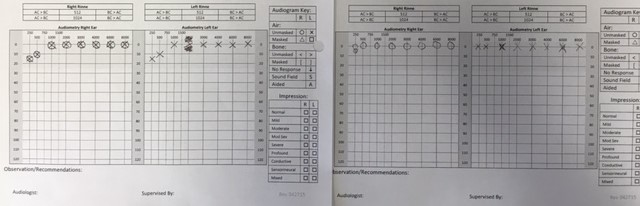
After our hearing tests, our charts determined that Jonathan had normal hearing; however, he couldn’t hear the lower frequency sounds when the decibel amount was too low, while I had perfect hearing and was able to hear all of the frequencies even at 0 decibels (subtle brag… Jonathan was a little jealous of this).

Our completed hearing charts. Jonathan’s hearing chart is the one on the left while mine is on the right. Patients who come in with hearing loss will typically have points that are more towards the middle of the chart.:

IMG_0932 (2)

After our hearing tests, we had our lunch break followed by some routine hearing aid checkups. Many of the patients that the audiologist and I saw were participating in a study with a new type of hearing aid that sends a laser light down the ear canal that hits a light receptor on what was described as “a contact lens for the ear drum” which causes a motor to vibrate the ear drum and allows that patient to hear. This new technology is very advanced and groundbreaking.

Overall today was a very fun and informative day as we learned about a lot about the technology that audiologists use in the current day and age. I especially enjoyed being able to conduct the hearing test on Jonathan, and the audiologists told us that tomorrow we would be able to do more experiments on each other using different types of technology. I can’t wait! – Kiran W.

Day 2: We’re No Longer Scrubs!

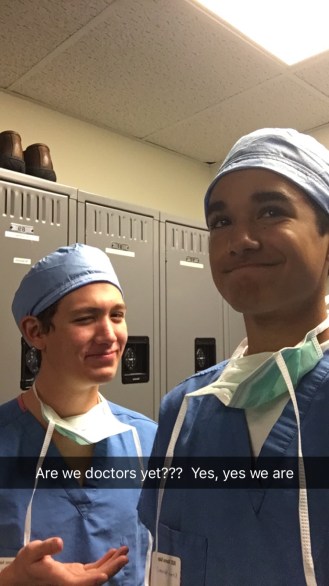
Today might just have been the coolest day that I’ve ever experienced up to date. Jonathan and I didn’t actually start the day at Carolina Ear and Hearing Clinic though; instead we woke up at 6:00 to shadow Dr. McElveen in an operating room at Duke Raleigh Hospital. When we arrived, we scrubbed up and received our official name tags to then follow Dr. McElveen to an operating room where he would preform a tympanoplasty operation.

IMG_0904

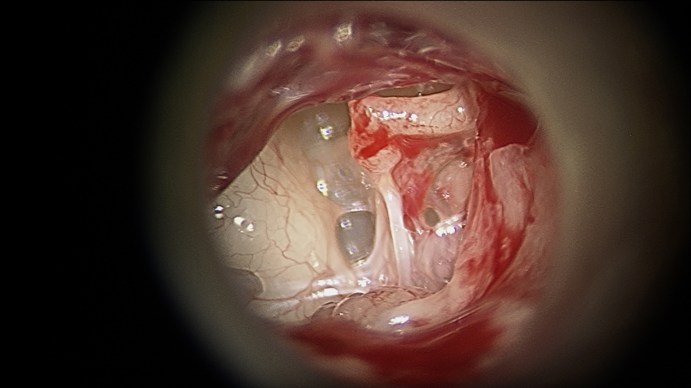
In the operating room, Dr. McElveen explained to us that the patient’s ear drum had collapsed when her Eustachian tube (a passage that permits the equalization of pressure on both sides of the ear drum) acted as a vacuum and sucked the ear drum in on itself. The collapse caused a tear in the ear drum, so the patient had a large hole in it. To correct this, Dr. McElveen cut cartilage away from the back of the patient’s ear and augmented it to her ear drum to patch up the hole.

The “middle  ear” of the patient during surgery, showing the stapes and incus bones as well as the folded-back tympanic membrane:

Surgery1

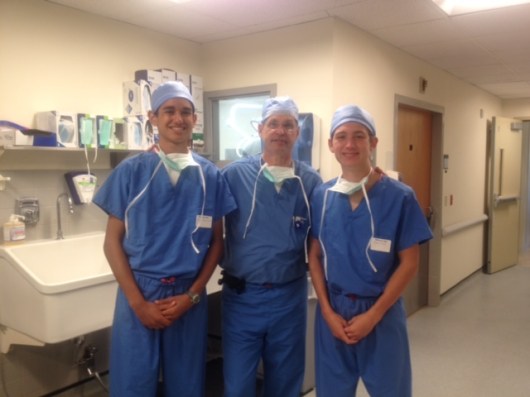
After the successful surgery ended, we celebrated with some pictures with Dr. McElveen and in our scrubs:

IMG_0929

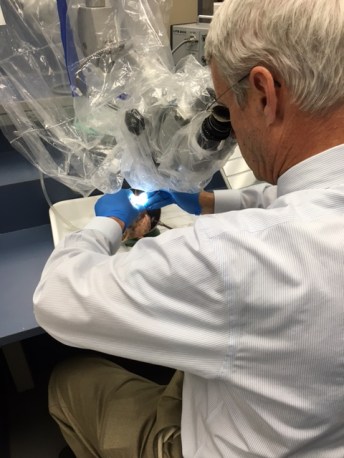
We then headed back to the Carolina Ear and Hearing Clinic where Dr. McElveen set Jonathan and me up in the clinic’s temporal bone lab. He let us probe a temporal bone and it’s ear cartilage, and it was really cool! However, we did find out how hard it is to actually be a surgeon from this because of how precise your instruments need to be held, and how hard it is to keep your hands from shaking when probing the patient’s body. The ear canal is so narrow that I felt like I was playing Operation since I wasn’t supposed to shake the probe and touch the sides of the canal!

Dr. McElveen demonstrating how to probe the temporal bone in the bone lab:

IMG_0908

Jonathan probing the temporal bone:

IMG_0909

After we (half) successfully probed the temporal bone and the ear cartilage, we had our lunch break. After lunch, Dr. McElveen had to leave to go to South Carolina to perform a surgery there. Thus, Jonathan and I separated and I went with one of the audiologists to examine a patient with a tumor on their hearing nerve called an acoustic nueroma. She conducted several tests on the patient in order to determine whether it was worth it for Dr. McElveen to attempt to save the patient’s hearing capability in the ear and remove the tumor, or if he should just incise the hearing nerve in order to remove the tumor, which would ultimately render the patient deaf in the one ear. One of the tests was to lay the patient down in a dark room and put plugs in her ears that would send sounds through her nerves and a machine would measure how long it took the brain to receive the sound. The patient had to lay completely still so that all of the body’s focus would be on delivering those sounds to her brain. Apparently she was laying so still that she actually fell asleep during the test! This was okay though according to the audiologist because the data still comes back accurately. After several tests, the audiologist determined that it would not be worth it for Dr. McElveen to attempt to save the patient’s hearing capability.

Today was such an amazing experience since we did so much observing and hands-on activities! I will never forget being in that operating room and observing the surgery; my jaw was dropped the whole time as I was in such awe of what Dr. McElveen was doing throughout the operation! It was also a very formative experience, and it definitely sparked my interest in possibly going into surgery as a career option. – Kiran W.

Day 1: Patients with Patience

Day 1 at the Carolina Ear and Hearing Clinic was already a restless one… Dr. John McElveen had over 40 patients to attend to, and we were at his side in the examination rooms the entire time! When Jonathan and I arrived to the clinic at 8:00 AM we were first suited up with lab coats so that we at least looked the part of doctors (even though we didn’t fully understand all of Dr. McElveen’s medical jargon). The morning started with a staff meeting that we sat in on where the upcoming month pertaining to all of Dr. McElveen’s surgeries was discussed (mostly at least… an engagement was also announced during the meeting which provided some well-needed excitement to wake everybody up on an early Monday!). After the meeting, Dr. McElveen had to rush to get on a conference call, so some of his nurses took Jonathan and me on a tour of the office and let us sit in on some of the hearing tests performed by the audiologists. The audiologists were very good at explaining what they were doing as they went along, and what all of their charts indicated in the patient’s file. After Dr. McElveen’s conference call had ended, he pulled us out from the hearing test rooms as it was time for him to begin examining patients. We hopped from room to room as Dr. McElveen examined the patients’ ears. Conveniently, on his magnifying device that he looked into to see the ear canal better was a camera that displayed and enlarged Dr. McElveen’s procedure on a television screen. Most of the times it was really cool to be able to see real-time footage of Dr. McElveen scanning the ear with his instruments (he was very good with pointing out certain things in the ear to explain stuff to us as he went along); however, some of the times it was kind of gross, like when he removed all of a patient’s ear wax or scraped away their dried-up ear fluid. The worst was when he used a suction tool to suck up all of the patient’s pus-like ear fluid. Jonathan and I stood there staring at the screen pretending to be professional and unfazed by the nauseating pus-fluid, but we later admitted to each other that we were both repulsed by it. After seeing all of these repulsive and gross bodily substances, it was time for our lunch break… perfect! Despite this, lunch was actually really enjoyable because we became much more acquainted with Dr. McElveen’s staff who is a really fun group of people. After our lunch break, Dr. McElveen had Jonathan and me research some common medical procedures and terms such as cochlear implants and otosclerosis. One of the nurses then explained to us how some of the advanced hearing aids worked and how to custom-program them to meet a specific patient’s needs. After this, we rejoined Dr. McElveen and continued shadowing him in the examination rooms until the office day was over at 5:00. Although Jonathan and I complained to each other throughout the day about standing up for too long without sitting (it’s actually a pretty challenging task that we are not accustomed to doing on a daily basis), we have absolutely nothing to complain about regarding our day as a whole, or the Carolina Ear and Hearing Clinic. It was truly an amazing and informative day, and we cannot wait to shadow Dr. McElveen in the operating room tomorrow during a surgical procedure! – Kiran W.

image1