Today I researched dynamic light scattering and zeta potential. Changing the pH adjusts the charge of the particles and prevent aggravation to increase shelf-life. Ideally, all the particles will act as separate particles and not join together as conglomerates. The pH can induce a charge formation because the negatively charged particles will repel each other (as can surfactants and legions). I spent some of my own time learning about dynamic light scattering before participating in the experiment. Basically, it’s a way of determining size distribution of small particles or polymers in suspension in a solution. A laser is shot through a sample scatters lights of the particles and is collected by a photomultplier, and the resulting image is collected like static on a television. The speckled pattern can be analyzed to find patterns and trends. By the way, this is all based on Brownian motion, the idea that random motion of particles suspended in a gas or solution. Then, I participated in the testing of some of these samples before attending a lunch seminar on biometrics and policy. The lecture was very interesting study on stress in police officers in Durham (right after the famous Veil of Darkness Study conducted by RTI to test police officer bias) using high tech versions of fit bits. The emphasis was on the intervention of stress in this field in the future, based on the collected data. Directly afterward, I attended a conference call about the upcoming HIV project being presented on Thursday. To end the day, my pipetting skills were put to the test. I pipetted many test tubes with a buffer solution I mixed and diluted. Not only did I get to pick the music while doing so (sorry for the abundance of Train Phil), but I also had the opportunity to learn some more about excel in the process!
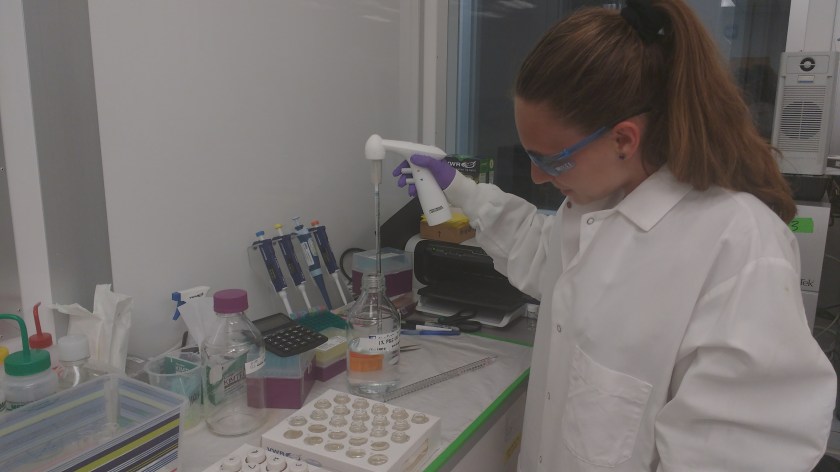
Lean mean pipetting machine!
 CA Work Experience Program 2016