Day 4- Autism in the Media

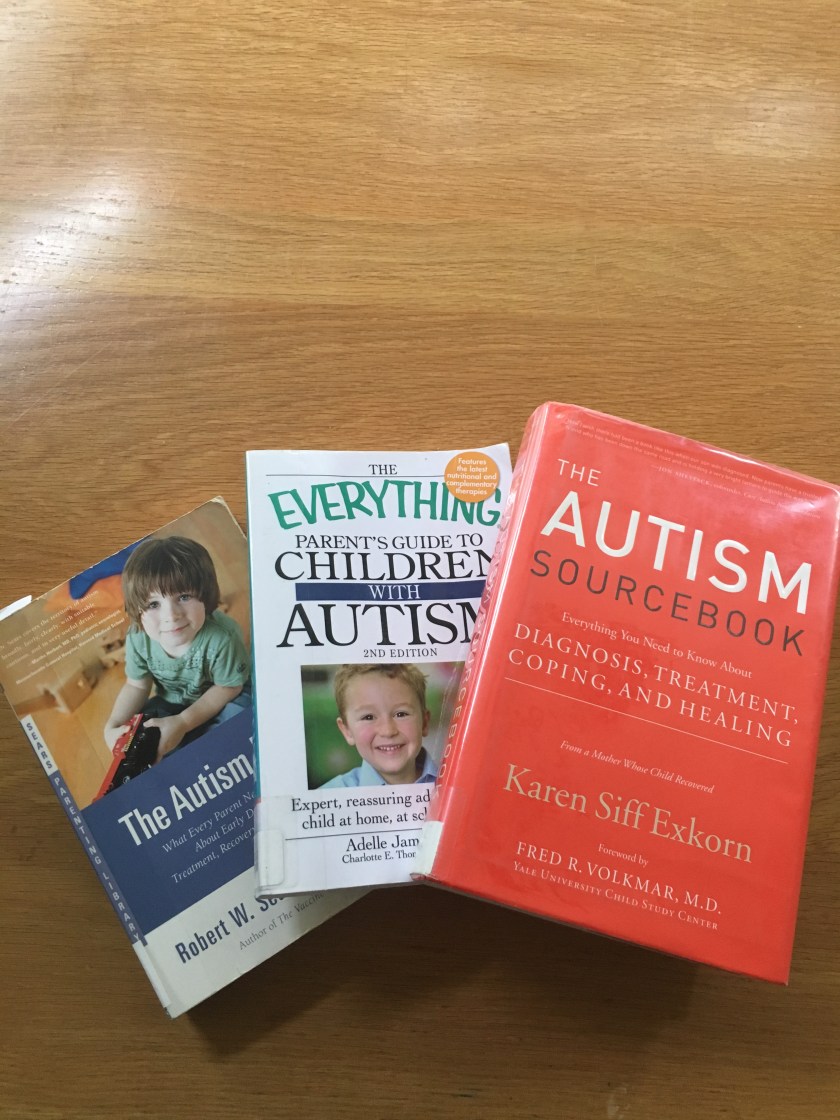
Camp counselors were arriving at Camp Royall today, which meant that they were doing mostly “get to know everyone” type of activities. Instead of driving out, my day was devoted to learning as much about Autism as I could. I went to the library and picked up these books to use as resources which I spent most of the morning reading in the CA library.

Autism books

Dr. Mac also sent me a link to “Autism: The Musical” which follows the lives of 5 autistic children and their parents as they organize a musical production. This movie was available on YouTube, so I watched this to learn more about the varying types of autism each of these children has. I also found a book in the CA library titled “Born on a Blue Day: Inside of the Mind of an Autistic Savant”, which was the autobiography of Daniel Tammet a man with savant syndrome which means he is not only autistic, but has mental capabilities far beyond the norm. In Tammet’s case, he is able to perform complex mathematical problem in a matter of seconds and associates shapes and colors with numbers. He references the classic movie “Rain Main” in the book which led me to do some research on the movie. Although I was unable to watch it, I read the plot and watched the trailer to find it is a story of an autistic man and his brother. These movies and books are all great example of how the media is an amazing way to raise awareness for individuals with Autism Spectrum Disorder.

-Fiona

Day 5 – What Does This Button Do? (WNCN)

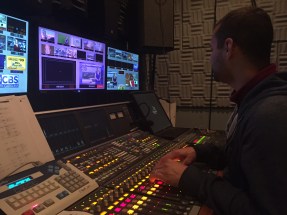
Day 5 was an early one. I was scheduled to arrive atWNCN - Dishes SEVEN in the  morning! It was a little rough at first, but totally worth it. When I arrived I met John Lindsey, a news director at WNCN. He gave me a quick tour of the building before we started doing anything else. After the tour I sat with John in the control room as he explained how they do the cut ins. Cut ins are, well, when the station cuts into the national programming to do local new and/or news. These happen at specific times in the program which are broadcasted to the local stations. The director of the cut ins will code the program they use before they begin. The director, the sound editor, and the camera operator all work together to produce the cut ins. I sat with John during the first cut in. Funny enough as he was trying to code the show he coded the wrong one so he pretty much winged it. It was a bit sloppy but it seemed to turn out okay. For the next cut WNCN - Sound Boothin I sat with the sound editor. He control the levels of all the different sound inputs, such as microphones, any music, and sound from videos. He makes sure that nothing is too loud or too soft and that all the needed pieces can or cannot be heard at a given time. While they weren’t doing cut ins myself and an intern got to mess around with the sound board and coding the show a little bit. For the next cut it I sat with the camera operator in the studio. She controls where the cameras are facing and makes sure that they are in the right places at the right times. Earlier in the morning she also sets up all the camera angles for most of the day. She is the one who cues the reporters or meteorologists as well. She makes sure they know how much time is left in the spot which is fed to her by the director in the control room. She was a very funny woman who was almost always singing into the coms. For the last cut in I sat with the director in the control room again, only this time it was the intern who was doing the directing. She did a very good job, everything went according to plan.

Once I had spent about two hours in the control room/studio, I sat in on a news meeting. The reporters that were there along with the producers of the news shows that day were discussing what stories they had or expected to get that day. After the meeting was over I sat with the producer of the 12 o’clock show. He was setting out what was going to go when and picking out clips from footage for the editor to edit together for the packages he needed. I asked him a lot of random questions about things I saw int he room. I asked him about things such as the analytics system they use, it’s the same as the N&O, in what circumstances do they like using live shots vs. pre-recorded shots, what he does on a standard day,  and others.

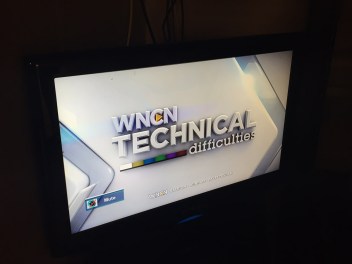
After that I sat with an editor for a while. He was the one who was working with the producer of the 12 o’clock to edit all the packages he nWNCN - Technical Difficultieseeded together. The editor had a tv in his edit bay that I ended up watching a bit, then suddenly the feed went down. For some reason, I never found out why, the channel began to experience technical difficulties. When the station first sort of came back online I was told that it was showing their old logos and color schemes. They were recently partnered with CBS locally and so they changed their look. The editor told me that the corporates probably wouldn’t be fans of the fact that 1)  The station went down, and 2) That they were showing older logos. After about 15-20 minutes the station came back on.

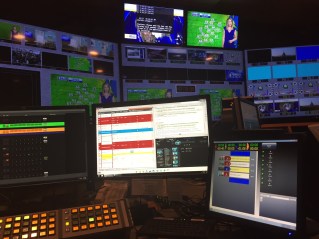
Then just before 12 I went back to theWNCN - Control Room control room to observe the 12 o’clock news from behind the scenes. Coolest part was I got a mini job. I was tasked with pressing play on a live streamed view of the beach just before it was supposed to be shown live, so that we wouldn’t run into ad problems after the original feed broke down. The show itself was pretty standard, but really cool getting the back stage look at what goes down.

Day 5- Making my own gif !

I know I continuously rave about how fascinating everything I’ve done each day is, but I honestly cant help it- it just gets better and better! On Friday I spent the day with Mike, a motion picture designer and art director. I shadowed him as he went to a team meeting and also went to oversee a rough edit of one of the videos an editor had put together. He provided his own critique to the editor and gave suggestions on where to keep the artistic focus and message as well as how to tweak the edit on certain moments. Later, as I mentioned to him that I loved film, he showed me videos on the filming process and some of the work that a motion picture designer would add to a film. It was shocking to me just how much of a clip or even movie as a whole, is actually animated. We talked about certain elements of film such as color correction, music and timing and watched various videos that showed the importance of each element. After talking for a couple of hours about pretty much everything you can imagine involving film, Mike kindly offered to show me how to animate a gif! Seriously guys- I can not even begin to tell you how excited I was in that moment. Although the process was complex and probably took me ten times the amount of time it would take Mike, we ended up creating a pretty cool little clip. What a fun opportunity!

Evie IMG_2564

Mexican and Aerosol

If you find this title confusing you should. The two do not go together, but somehow at RTI the most seemingly separate of things come together in a beautiful synthesis. Each person, each member of the team, each sector of RTI, is filled to the brim with professionals that facilitate the marriage of outlandish theories in the most innovative of ways. My day was not any different. It started a little slower than normal (it was a Friday after all), but what I’ve learned about  RTI is when things pick up they never quite stop. I did some light reading in Science News, a weekly press release that covers interesting journal articles from a variety of science fields. Then Phil taught me about the tuberculosis project they are currently working on. Basically some drugs referred to as POA and PAE (one is an ester and one is an oil) were made into uniform powders using a complicated processes that I will not go too in depth into. This process is preformed in several meticulous stages to “purify” these solutions into fine powders. The drugs work by binding to an enzyme present in some strands of TB, which allows it to be absorbed into the think layers of the TB bacteria. The drug changes into its -OH form to target the TB in the lungs. The peculiar part is that, although the drug greatly reduces TB in the lungs, (where it is dispersed) it completely eradicates the disease from the spleen. How curious. Almost immediately after this explanation (which was accompanied by data and a pretty nifty slideshow), I sat in on a conference call with both Phil and an aerosol specialist named Tony. The conference call was with a representative from an video journal. There used to be a device on the market used to administer aerosol drugs for animal testing. Recently, however the company has ceased production and there is no longer anything available for this administration. RTI has created a sterile device akin to the originally manufactured to be released soon. Because the production of it is best understood with pictures and diagrams a traditional journal format would not be ideal, so they are interested in using this new video journal formatting. The conference call never ceased to be interesting, but I found myself even more enthralled in Tony, himself. I got to talk to him in length after the call and it was really interesting to hear about how he became involved in aerosols and what his prospective on modern day innovation is (plus he has written a ton of books and papers that are beyond cool). Around lunch, Dr.Rothrock, Cameron, Michelle, Phil, and I went to a Mexican restaurateur to eat lunch, where Dr.Rothrock shared her own story and described her job. Of course, the day could not go on without some final lab tests (I’m getting pretty fast with it by now) amidst some new funky tune Phil has found on Spotify! What a day! What a week!

(I apologize for the lack of pictures today, but a good portion was confidential and could not be photographed)

Day 5 – “Are we too efficient?”

Hello friends!

Not much to talk about today, sadly. Due to the phenomenal (if I do say so myself) work ethics of Mrs. Michelle and myself, we finished a lot of work during the first four days of this week. Unfortunately, our enthusiasm was not successfully mimicked by he rest of the department, so the last major project was delayed since we didn’t have the neccessary devices yet.

However, despite this tragic set back (absolutely tragic, I tell you), we were able to plow forward and make progress on the set back project, and we also aided other groups, which included work on a new inlet for the ECMs, to testing the optical density of some data Dr. Thornburg sent back from India.

In addition to our work, Emily and I also met with Mrs. Ginger Rothrock, one of the more senior workers at RTI. To those of you wondering, yes, this is the wife to our beloved sixth grade science teacher, who left some years ago.

Since there were no new projects or experiments today, I didn’t manage to get any attention grabbing photos. However, we should have the neccessary requirements to begin testing on a new project next week, so tune in for some awesome experiments on Tuesday!

Have a wonderful weekend!

–Cameron

Day 4: The Prescription

I apologize for how late this post is, it is meant to be for Thursday May 26. Due to cross country travel and the busyness of a speech and debate tournament, I was slightly delayed posting.

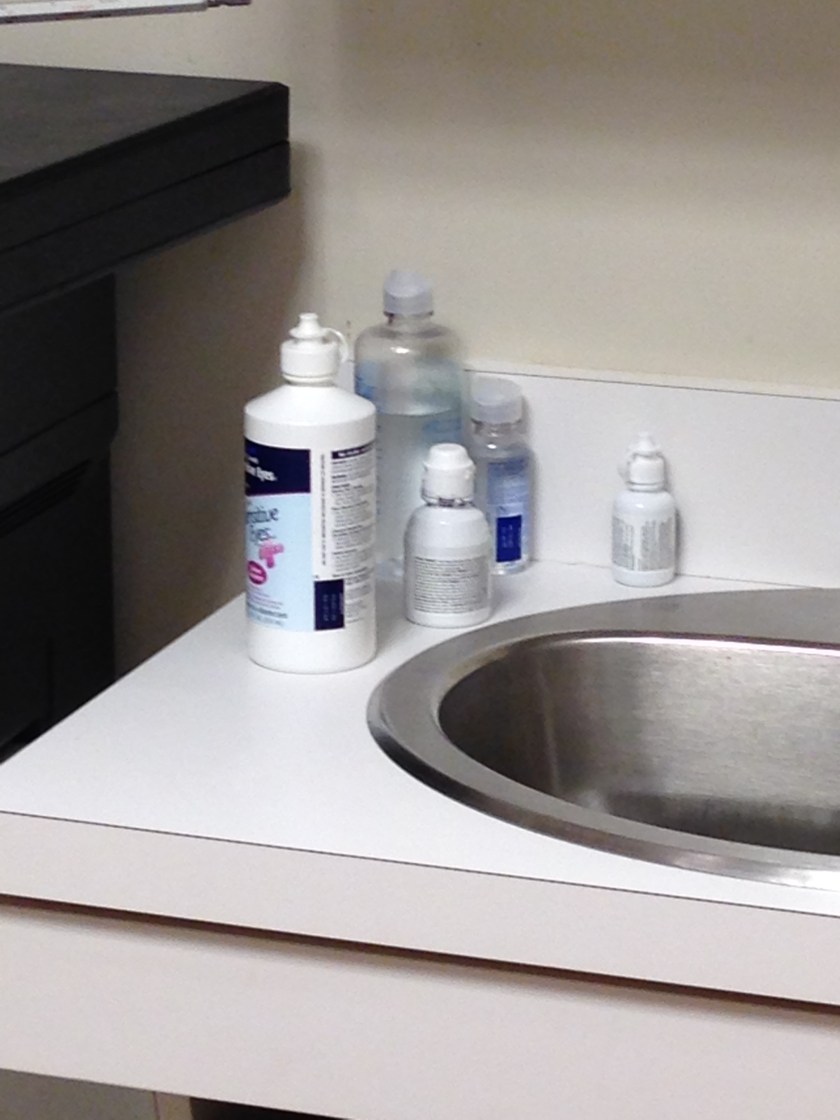
This morning Ms. Allen payed us a visit at the Eye Center. We got to talk to her about the experience and finally gave her a tour of the center. After that I continued to shadow Dr. Besharat and I watched her conduct some tests she did conduct previously. She used a dye on the eyes of her patients to check for abrasions and other imperfections on the surface of the eye. Afterwards she conducted an exam on me and went through all of the standard procedures from checking the strength of my eye muscles to checking the health of my eye. Everything checked out! She also tested my prescription and I learned that I needed a new prescription which I was given. Finally, I was able to see Dr. Besharat check patients for potential tumors on their eyes. The below image is of the many bottles of dyes and solutions the doctor’s use on a daily basis. Some are lubricating drops, others are to control allergies, and others are for contact lenses. One of the bottles contains the dye in it.

IMG_1611

Day 5 – Painful Farewell

Today I started my day early. Today was a busy day because they’re closed on Monday (for Memorial Day). I got to see a lot of different patients. I recognized a lot of patients from earlier this week. It was nice to see them again and see their progress.  One lady just had ACL surgery yesterday! I was suprised she was already at her first PT session today.

A bunch of paid athletes came in today for PT. They’re so fast and they have done multiple half iron mans! After hearing about all of their hard training, I was not surprised that they had so much pain. For example, one woman had a tight hip and hamstring, and will have to get an MRI next week to check up on it.

There was more dry needling today. The dry needling was used on the calves, hips and shoulders today.

IMG_7669

I continued to wipe off tables after each patient left. I sprayed the table with disinfectanct and then changed the pillowcase. Once the table and pillowcase are clean, I turn the pillow parallel to the table (like in the picture above).

A patient from earlier in the week was here again today. He used the total gym to do leg presses to strengthen his knee.

IMG_7666

The Total Gym was used on a patient that had ACL surgery. The Total Gym is a great way to strengthen the knees and quads.

One patient has been going to physical therapy for a while now, so he is able to run again. He had shin splints, but after weeks of physical therapy, he was able to run a few minutes on the treadmill.

IMG_7667

Treadmill that patients can start running on.

It was tough to say goodbye today. Since I am going to the West Point leadership camp tomorrow, today was my final day at Raleigh Orthopedics. I learned so many exercises and I am so glad I had this experience. This week helped me decide with what I want to do in the future. Also, this week has made me so thankful that I haven’t been injured (knock on wood!) and I am able to live my daily life pain-free. If I do come across an injury down the road, I know that Mr. Meszler is an incredible PT and he will get me back on the road quickly.


UNC Press: Production & MORE FREE BOOKS!!!!

Hey folks! I’ve been at UNC Press again today, looking at more FREE BOOKS (!!!!!) and also visiting with the Production and Marketing departments.

IMG_4360[1].JPG

Production is where all of the copy-editing, cover and illustration design,  typesetting, and page proofing happens: all things that make sure that the final book looks polished!

Here’s an explanation of all the terms I threw into that sentence above:

Copy-editing is the process of editing “copy”, or writing, into something with correct grammar, spelling, and free of anachronisms or other inaccuracies. It’s different from “developmental editing”, which is the process of editing away errors in thinking or ideas, and different from “proofreading”, which is the process of editing again for things that copyediting might have missed.

Cover design is what it sounds like– but also the process of deciding what color the end papers (the paper glued to the “case” or hard cover of a book) are, what color the stitching is, whether the book will have a “printed cover” (where a printed paper is glued to the case of the book), whether the cover will be cloth, and  designing the “jacket”. Obviously, there’s lots of details that go into the design of the actual book!

Typesetting is the process of taking the text and deciding how the “interior” of the book will look– the inside, where people actually read the text. Most typesetting happens now in InDesign, which is the same program the CA Lit Mag uses to design its publications! The typesetter decides what font the book will be in, edits the font to get rid of any weird spacing issues, decides how big the font will be, and many other wonderful things that I don’t know about. One of the important things that happens here is that the number of pages should ideally be in multiples of thirty-two: because “signatures” or groupings of pages are least expensive when they are in groups of thirty-two. This is why books sometimes have blank pages at the end: because it is less expensive to print blank pages than it is to have signatures in groups other than thirty-two!

Page-proofing is the process of, once everything is typeset, making sure that everything looks good and that, once again, there are no inaccuracies or typos. This is one of the last steps before the book is sent to the printer: so it’s important that all of the errors are caught!

Finally, the page proofs are “folded and gathered” — turning them into books with “signatures” of 32 pages folded in half, “gathered” or sewn, and then finally checked yet again for problems.  This all happens on the paper that will be used for the book, which is always of higher quality than the paper that comes from your printer.  Sometimes a cover is also printed out to make sure that the spine is the right width for the number of signatures that goes into the book.

And then the book is sent to the printer and, magically, becomes a book!

After that we go to the magical world of marketing, where author events, blog posts, and other things that sell the book happen.

Overall, UNC Press has been a great place to work in the past two days! I’ve definitely learned a lot about what goes into making a book a book, rather than an unedited manuscript sitting on somebody’s desk. Super cool, right?

Check here later for news from Flyleaf Books and Quail Ridge Books!


Liza Day 4: The Favorite

Out of the four days I’ve been here, today was probably one of my favorites. I came in and got right back to work on finding footage. Around 11, Josh and I sat down for coffee and discussed my interests and which department they would best fit into. I’ve mainly been working with production this week (as I’m shadowing an Executive Producer), but I found it fascinating to learn about all the different departments and how they play a crucial role in what McKinney does as an agency. Josh grew up in Taiwan and then moved to NY in high school. By the age of 17, he knew he wanted to make movies and attend art school, which I find very impressive. As I mentioned in the last blog, I asked Nick similar questions about his path to production and advertising. Listening to Josh tell his “life story” was extremely intriguing as Nick and even Miriam had completely different lives before McKinney than the life Josh had. Moreover, I love hearing about how people with distinctive backgrounds can end up working together for the same agency. Josh also introduced me to possible work experiences and internships I could consider when finding a job in the film and media industry. As I know Josh is extremely busy, I appreciated his insight and the time he took to discuss life as a producer with me.

Before the 12:00 meeting, I met with Erin, a studio artist for McKinney. She studied graphic design in college, something that has always interested me ever since I was in middle school! Erin walked me through her current project with “World of Coke.” She designs all the still advertisements for McKinney’s clients such as billboards, magazine ads, newspaper ads, and so on. I was amazed to learn that every single advertisement (picture, super, etc.) can only be used once. For example, an ad in a newspaper can’t be transferred and used on a billboard. An ad selling Coke in a specific magazine also can’t be repeated and used by another magazine company.
Additionally, Erin showed me Coke’s Brand Guideline that discusses the do’s and don’ts when McKinney is their AOR (agency of record). Each one of McKinney’s clients has a Brand Guideline, but it was so cool to see the detail a large company like Coke went into when creating a permission document. I realized that as a studio artist, the intersection between mathematics and design is used day in and day out. Because my two favorite subjects are math and any type of art & design, I was thrilled to learn about this possible career option.

At noon, I headed over to the conference room to sit in on a meeting for the new pitch. I enjoyed seeing the Creatives (who come up with the commercial idea), the producers, and the editors come together and review the work they’ve accomplished so far. We were able to watch a few complete commercial ideas, and I even saw my footage being used in almost all of them!

After watching certain commercial videos, the Creatives would respond both positively and negatively. For example, one Creative said “I’m not feeling what I want to feel.” He recommended changing the music and replacing some of the clips. “The contrast of the footage needs to be more jawing and more exciting”, said another Creative. I found it amazing to see how they came up with this “vision” and know exactly the way they want it to be executed.

After a delicious veggie burger at Only Burger, I came back to the office and continued working on my assignments and searched for more footage.

I’ve learned so much within my four days here, and I can’t wait to continue learning more!

-Liza

Only Burger

FullSizeRender (1)

FullSizeRender (9)

Creating Ideas

FullSizeRender (4)

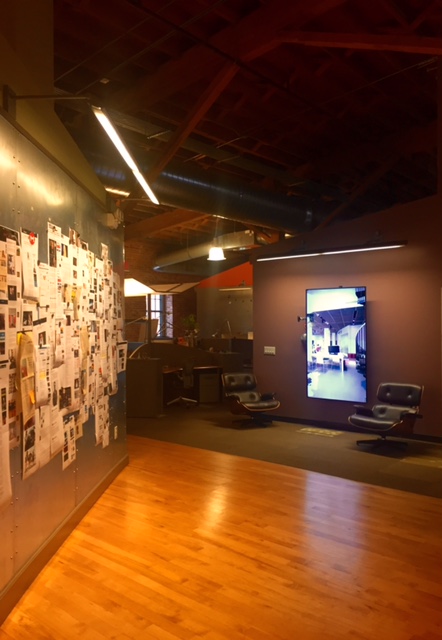
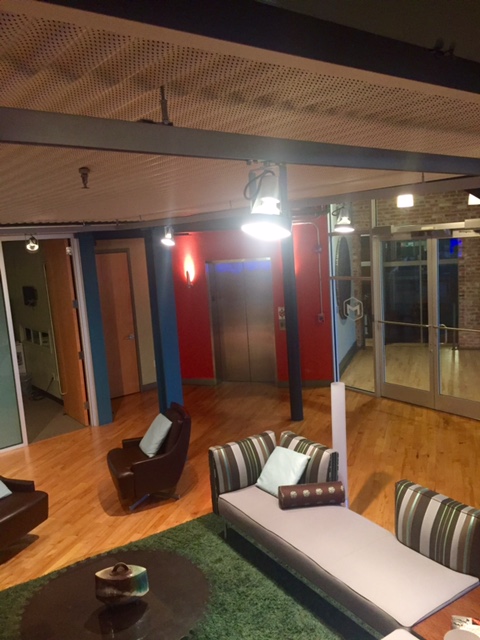
Such a modern space!


Liza Day 3: Hard Work Pays Off

What can I say, each day at McKinney seems to keep getting better and better! Throughout the morning, I continued searching Getty, Vimeo, and YouTube for all kinds of footage. In total, I’ve probably downloaded around 150-200 different videos and clips! This shows how important it is to have many options to choose from when making a rip. Also, because of the “perfectionist” I am, it takes me hours to find the “right” clip that I think would work well in the Creative’s commercial idea. I’ve had lots of fun doing this though because I then am able to see my footage come together and turn into a possible video that will be presented at the pitch.

After lunch, I observed how the two editors- Erin and Nick- take stock footage and turn it into a clean and curated video rip. This was awesome for me because they use a similar program that I’ve used in the past, Final Cut. I’ve worked with this program at home and in CA’s Video Productions Class to make edits, so I enjoyed seeing something I do for fun being executed in the real working world. Thank you Mr. O’Neill for introducing me to Final Cut last year! My experience using it has already paid off!:) Additionally, it was rewarding to see that Nick was able to use some of the videos and clips I selected over the past couple of days.

Towards the end of the day, I was able to meet with a different Nick who is a producer at McKinney. I asked him a lot questions about his career path and in particular, how he ended up at McKinney. It’s interesting to hear about what each staff member studied in college, whether they knew what they wanted to at an early age, and what brought them to the agency! Additionally, I’ve loved having the opportunity to connect with the staff here and observe their role in McKinney’s day-to-day routine.

Looking forward to my day tomorrow!

-Liza

IMG_6165

the entrance

FullSizeRender (7)

finding footage