Today Joe and I were able to find out what was going on with the time stamps for the data points and after a lot of time experimenting with the programming, and multiple calls to the manufacturer we were able to sync the time on the computer to the time stamps. After fixing the time stamps we measured the dimensions of the sensor to make sure it would fit on our cart. While Joe and I were over with the cart we were able to work on it for a little while. We were able to create a mount for one of the sensors that was movable so we can adjust the height. I have included a picture of the sensor at maximum height. 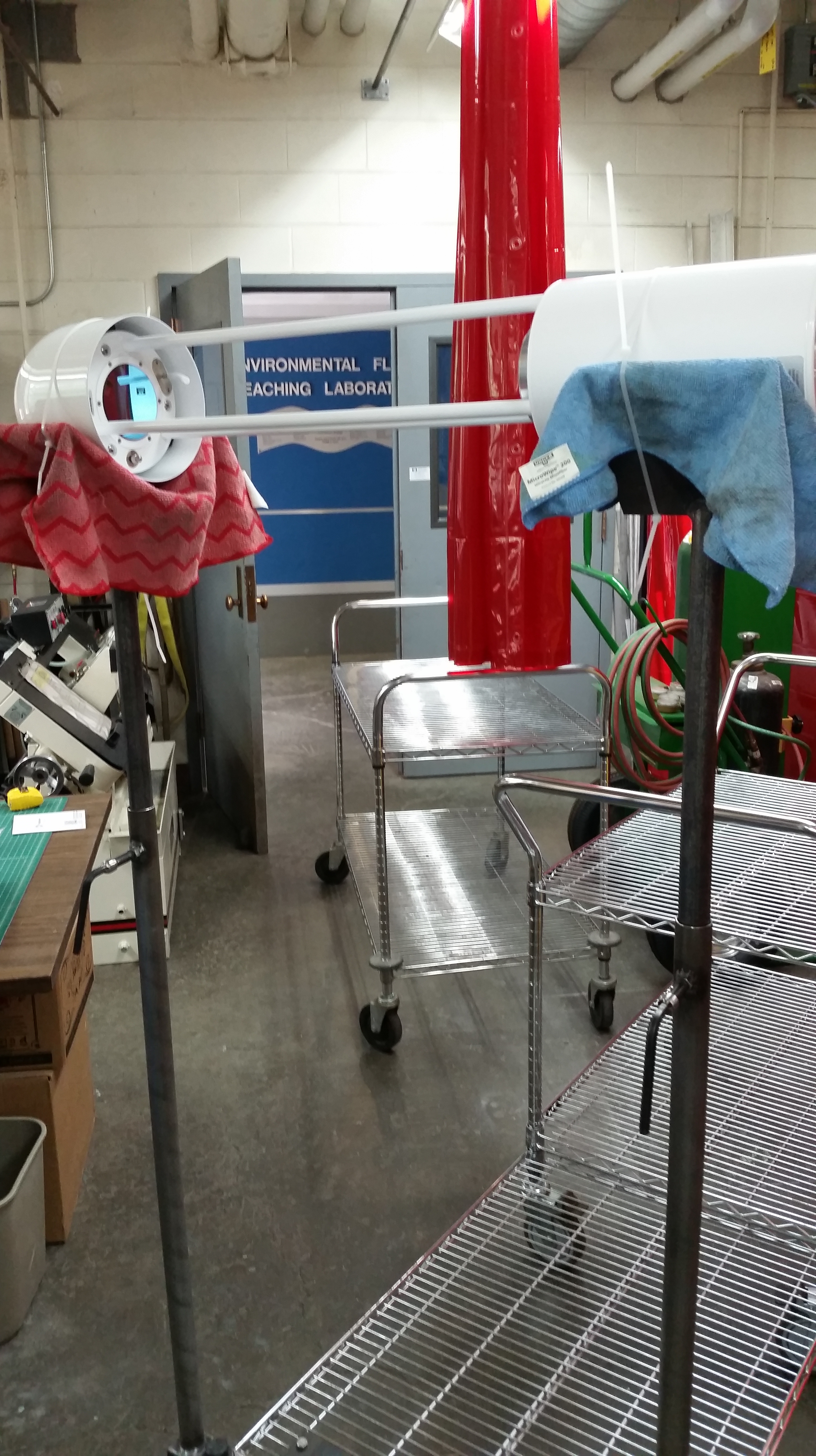
Author: cawep6
I sense more sensors
Today another one of our many sensors arrived so Joe and I had to try to work out how to use it. This sensor will be used to determine the concentration of methane gas in the air so we will be able to measure different concentrations as we drive a cart (with this sensor on it) through a plume of methane gas. This sensor seems relatively easy to use except for a few problems that we found. For instance when the sensor records data points there is a time associated with each point. This is important because we need to know the times so we know where we are in the plume. Unfortunately the time was around 8 hours off. Tomorrow we will work to try to fix this. 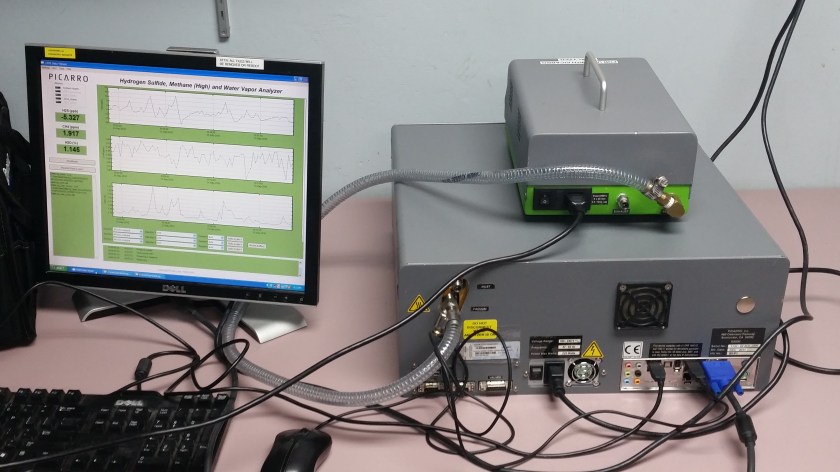
Drew Day 6 Photographer
to start the day we were in a meeting after talking with Dr. McElreath. The meeting was their weekly meeting just to go over all of there many projects to see how they are all doing. After the meeting I was told how they are fixing entry ways to waverly place the shopping center and the needed photographs of the different things they are retrofitting. They sent me to take the photos it was fun but that shopping center was very confusing it took me a little to figure out where I was on the map then it was all good and when I got back the last thing I did was go with to a rezoning meeting for one of there projects. The rezoning was more about what things are required from them in building not about where the building is.
These are the entry ways I had to photograph


Polymer = Many Things
Lets break it down…shall we…


Up close and Personal: Pictured above are two polymer films under a microscope
Today was all about polymers, which directly translated means many things. And they are not wrong, polymers are actually a combination of hundreds, thousands even, of molecule chains. This makes them easy to melt, easy to mold, and most importantly easy to work with. Some even go as far as to call it “hobby plastic”, because of its eclectic properties. A material scientist I met today, Stephanie, taught me how to make the polymer films used in the HIV prevention devices. I even made the solution using the calculations attached (thank you Mr.Rushin for making this possible)! Then she showed me two different films under a microscope. The polymer itself is a peachy color and the crystals actually refract light, making some pretty awesome rainbows. On the computer, however, the lens is black and white so the colors don’t really show.
Cameron and I also got to talk to several different scientists today as well. First we were introduced to Jeff, who is an aerosol specialists focused on preventing harmful contaminates and particles from being inhaled into the lungs. He is currently working on a project to create small measuring devices that can be worn by people with potentially hazardous exposures. Not only is his work interesting, but he was more than willing to give us life advice as well. He emphasized the importance of introspection and self-reflection when thinking about possible choices – whether it be college decisions or career paths. We also met with Sarah and Jeff, both are scientist specializing in polymers. They both shared their experience in the science field and how they got where they are today. They too encouraged us to take opportunities in college and to get to do as many internships and research as possible.
Calculations: Amount of PCL to use
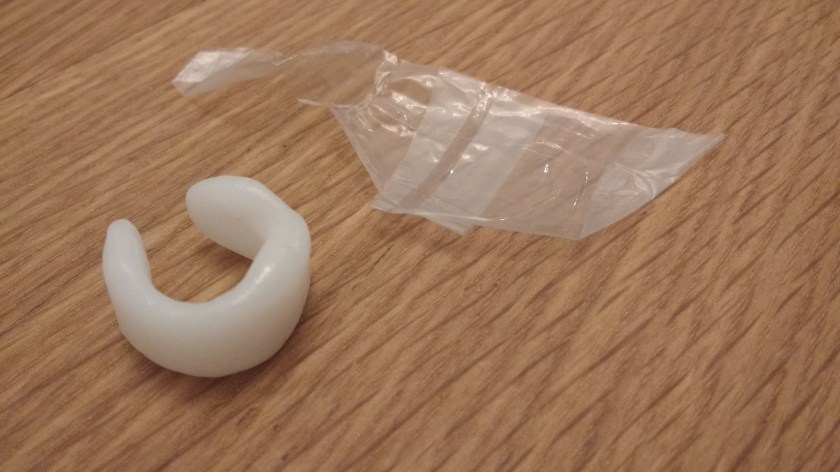
Some polymer film I made heat sealed together next to a polymer ring
More Safety?
It is almost like they want us to be safe or something. Earlier in the week Joe and I took multiple online classes about safety procedures, and today we continued to learn by having a discussion with the safety administrator regarding rudimentary sensors we would use as our canaries. I have included a rudimentary sketch of our plans.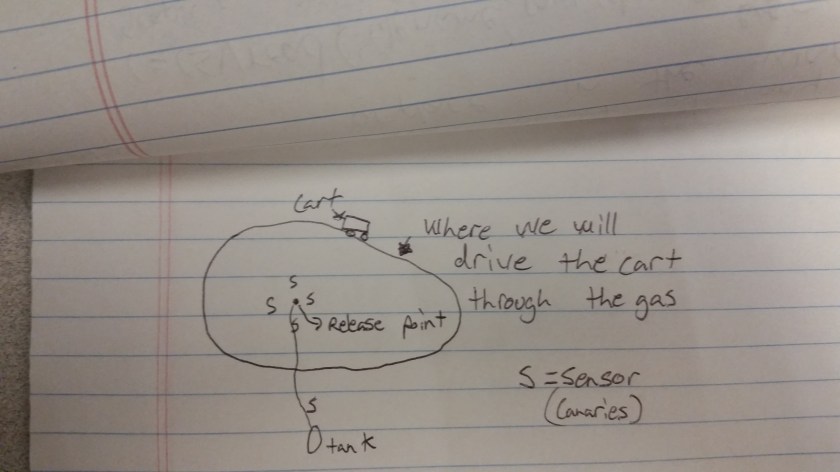
Mexican and Aerosol
If you find this title confusing you should. The two do not go together, but somehow at RTI the most seemingly separate of things come together in a beautiful synthesis. Each person, each member of the team, each sector of RTI, is filled to the brim with professionals that facilitate the marriage of outlandish theories in the most innovative of ways. My day was not any different. It started a little slower than normal (it was a Friday after all), but what I’ve learned about RTI is when things pick up they never quite stop. I did some light reading in Science News, a weekly press release that covers interesting journal articles from a variety of science fields. Then Phil taught me about the tuberculosis project they are currently working on. Basically some drugs referred to as POA and PAE (one is an ester and one is an oil) were made into uniform powders using a complicated processes that I will not go too in depth into. This process is preformed in several meticulous stages to “purify” these solutions into fine powders. The drugs work by binding to an enzyme present in some strands of TB, which allows it to be absorbed into the think layers of the TB bacteria. The drug changes into its -OH form to target the TB in the lungs. The peculiar part is that, although the drug greatly reduces TB in the lungs, (where it is dispersed) it completely eradicates the disease from the spleen. How curious. Almost immediately after this explanation (which was accompanied by data and a pretty nifty slideshow), I sat in on a conference call with both Phil and an aerosol specialist named Tony. The conference call was with a representative from an video journal. There used to be a device on the market used to administer aerosol drugs for animal testing. Recently, however the company has ceased production and there is no longer anything available for this administration. RTI has created a sterile device akin to the originally manufactured to be released soon. Because the production of it is best understood with pictures and diagrams a traditional journal format would not be ideal, so they are interested in using this new video journal formatting. The conference call never ceased to be interesting, but I found myself even more enthralled in Tony, himself. I got to talk to him in length after the call and it was really interesting to hear about how he became involved in aerosols and what his prospective on modern day innovation is (plus he has written a ton of books and papers that are beyond cool). Around lunch, Dr.Rothrock, Cameron, Michelle, Phil, and I went to a Mexican restaurateur to eat lunch, where Dr.Rothrock shared her own story and described her job. Of course, the day could not go on without some final lab tests (I’m getting pretty fast with it by now) amidst some new funky tune Phil has found on Spotify! What a day! What a week!
(I apologize for the lack of pictures today, but a good portion was confidential and could not be photographed)
Day 5 – “Are we too efficient?”
Hello friends!
Not much to talk about today, sadly. Due to the phenomenal (if I do say so myself) work ethics of Mrs. Michelle and myself, we finished a lot of work during the first four days of this week. Unfortunately, our enthusiasm was not successfully mimicked by he rest of the department, so the last major project was delayed since we didn’t have the neccessary devices yet.
However, despite this tragic set back (absolutely tragic, I tell you), we were able to plow forward and make progress on the set back project, and we also aided other groups, which included work on a new inlet for the ECMs, to testing the optical density of some data Dr. Thornburg sent back from India.
In addition to our work, Emily and I also met with Mrs. Ginger Rothrock, one of the more senior workers at RTI. To those of you wondering, yes, this is the wife to our beloved sixth grade science teacher, who left some years ago.
Since there were no new projects or experiments today, I didn’t manage to get any attention grabbing photos. However, we should have the neccessary requirements to begin testing on a new project next week, so tune in for some awesome experiments on Tuesday!
Have a wonderful weekend!
–Cameron
Drew Day 5 Working the site
Today was a half day we started by heading over to the TOA site and looking around he explained everything that was going on in the building and how they are building up for the MRI pad and what each bracing was as well as how the built the building it is a leaning technic were the build the cement walls on the ground and lean them up it is a more cost affective way of building. At the site we had the meeting they talked finance and how it was coming in under budget so what my boss said was that the meetings can be tense if things aren’t good like they were today. Then they went over sign placement and I actually pitched in an idea that they actually decided on in the end which was to make the sign a triangle and then the day was over. 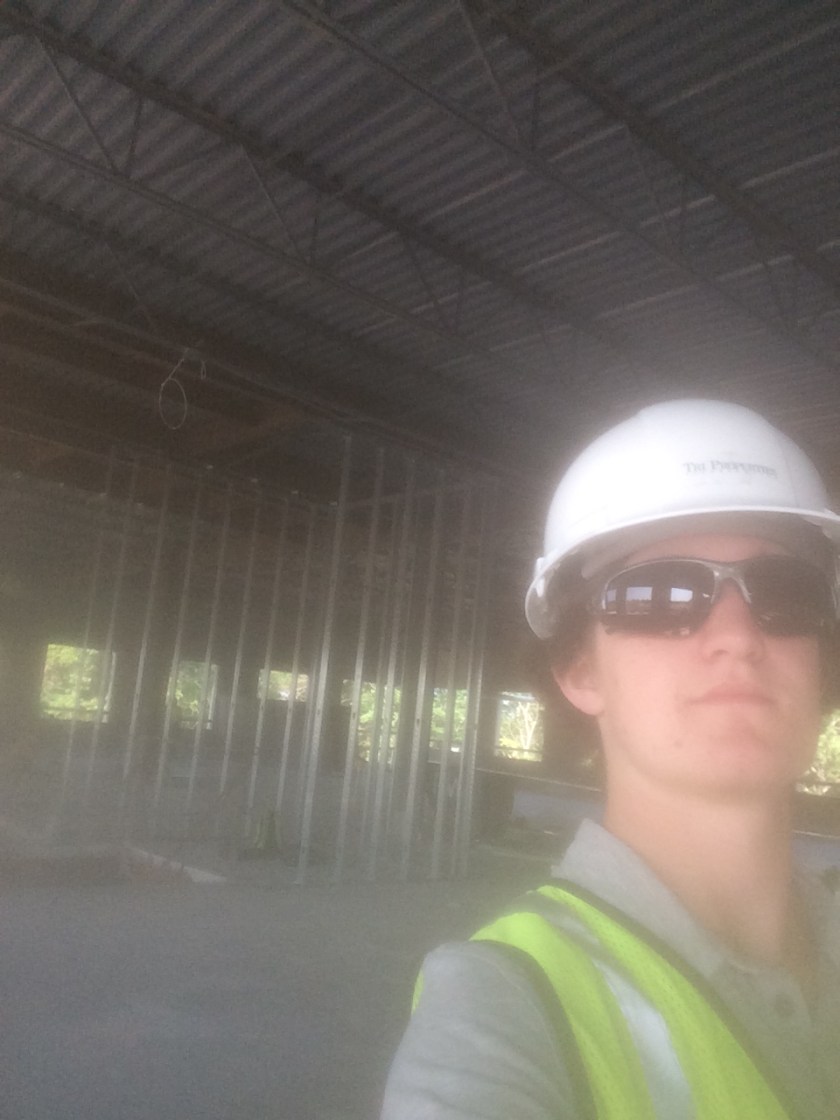
Drew Day 4 the less exciting side
I was in the office all day today we had a finance meeting to start the day just talking about are there any tenants in any of there buildings not payed for at the moment and how much and do they need to pay anyone at the moment. The next thing we did was answer some calls fill in some of the people about the conference room upgrade from yesterday and then another person in the office gave me a job. I was working on a property inheritance so I had to find how much each of the persons 6 properties are worth and the space it took up and I marked those places on 15 different maps to find this information I used the wake county tax website and the wake county gis which stands for geographical information service which is where you type in an address and you can find out what it costed and how much wake county thinks it is worth. Then we went to a 25 minute lunch to catch a phone meeting about the permit and what on the land was not all the way up to code yet for there PDC project. Then before I went home we had to prepare for the meeting today for the triangle orthopedics MRI pad which is what the picture is of it is to help figure out where the sign can go which I found out is a lot harder to figure out than I thought the pink lines are where the power lines prevent the sign from going and the yellow is the sidewalk and it can’t go there so on the other map s the orange are the 2 options for what the sign can be and where.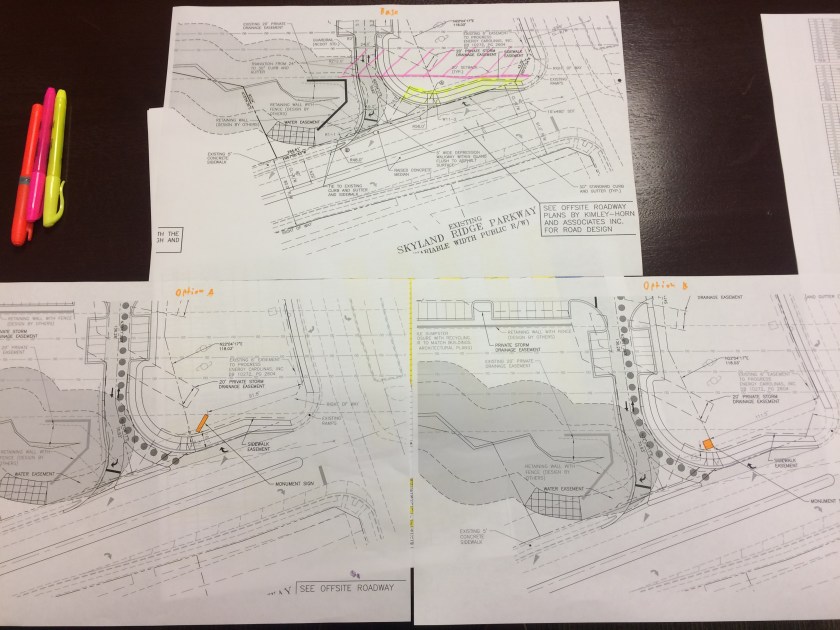
Cool Conference Call
From beginning to end, the day could be described by the word productive. First thing Cameron and I met with a man named Lynn. Lynn specializes in LEDs, mostly working with variables like durability, color, brightness, construction, etc. HE even described a new technology innovating the light industry: phones. Now phones will be able to control lighting in a way never seen before. In cities with high crime rates it can be possible to install audio devices in outdoor light fixtures to detect gun shots and alert authorities. He also took the time to get to know Cameron and I and talk about the college process and a typical day in his position. After the meeting I got to meet Michelle, Cameron’s scientist, and she explained the devices they are working on to measure the amount of harmful particles created by cooking stoves in impoverished countries. After this, I spent a good part of the day cleaning the lab before the big conference call. During my awesome cleaning experience, Phil introduced me to polymers – a plastic with a low melting point which makes it easily melted and molded. When the plastic hardens, however, it becomes very durable and solid. We melted some of our own polymer in hot water and I scupted it into a ring . Next came the more serious part of the day! The “conference call” was really a high profile meeting explaining the outcomes of the testing (on the HIV project) to major donors. We watched the presentation on a projector and listened to the conversation (in case Phil had to be called on to explain a part of the research), while simultaneously running tests for the HIV project. At one point I observed plastic under a microscope to view the individual crystals. I also got to do much of the tests (yay pipetting!) on my own today. Nothing like science and a movie to end the day (or a conference call and some testing is good too)!
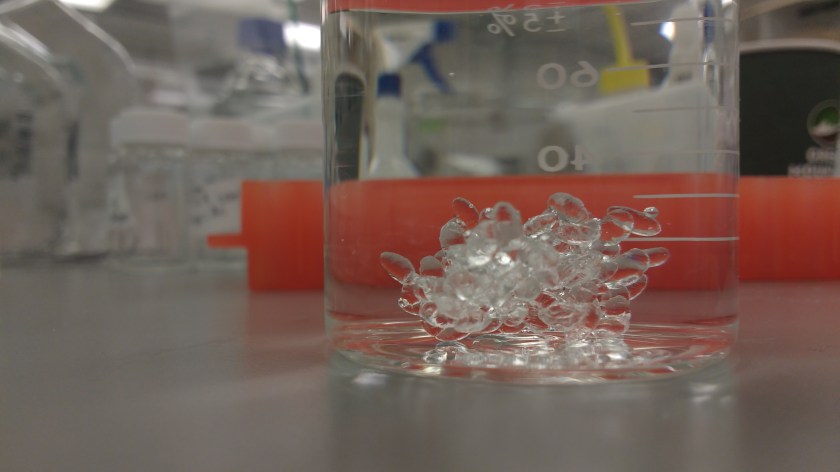
Polymer!
 CA Work Experience Program 2016