I’m Back & I’m Better (Day 3 @AMM)

Today has been the busiest day yet. Dr. Lewis started seeing patients at 8:30 am and I followed her as she went about her day. Dr. Lewis encourages me to ask questions (I’ve had many!) and does not hesitate to answer them. Today our discussions included tuberculosis, the difference between a CT scan and a MRI, interferons, hepatitis, and much more. Then, I had about an hour for a lunch break. Before I had lunch, I stopped by Ms. Daniel’s office to see if she needed anything. There were some patient packets that needed to be made so I worked on putting the packets together after I ate. When the lunch break ended, I met up with Dr. Lewis and continued shadowing her until 3:30 pm. Today was a longer day than the first two, but it was no less interesting, enjoyable, or educational.
-Biruk


Day 3: My Own Pre-Screening

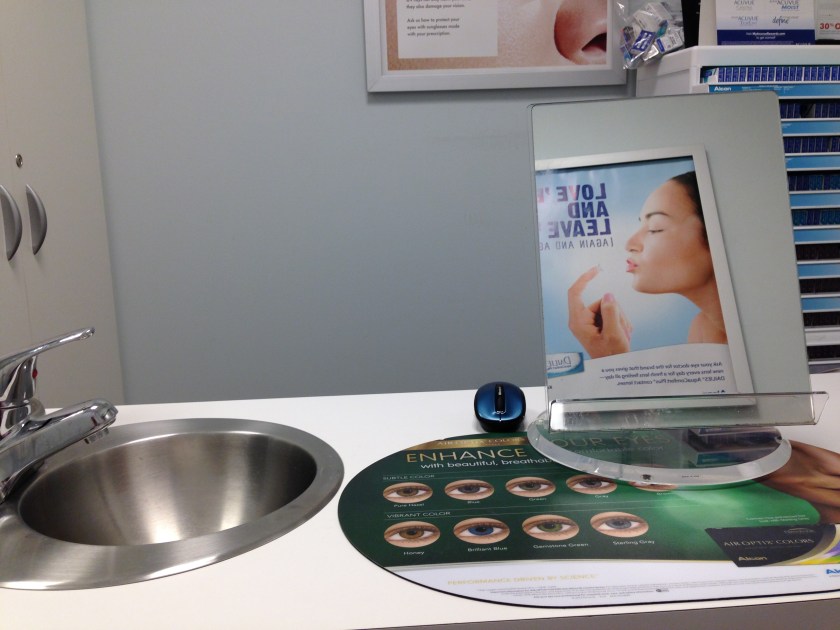
Today I had the opportunity to learn how to operate the pre-screening machinery in the office. I got try them on one of the technicians in the office. After that, the technician created a chart in the office’s system for me and she did a pre screen on me. From there I learned what all of the tests look for and a little bit about how to read the results. I also got retinal photographs taken. I did some more shadowing today and got to take a look at there contact lens protocol the office uses and their dedicated contact lense room where they keep their lens samples and where patients can try on different lenses. The below picture is of the room:

image

Biomedical Engineering @ NCSU

I spent the day at NC States Biomedical Engineering Lab. I followed around a rising BME senior who showed me different projects he’s working on, as well as different research that’s going on. Here’s project for an exoskeleton design! (We couldn’t go in the room so I had to take the picture through the blinds). And here’s a tissue engineering research team taking bones out of mice! — Lindsay


Day 1: The Pre-Screening

Unfortunately I did not see Dr. McElreath’s email until returning home, I was kept quite busy today! I shadowed the optometric technicians today and watched them go through their normal test protocols. They conduct vision tests both with and without corrections (contact lenses or glasses). They conduct color vision tests without the correction and the depth perception test with correction. They also, if the patient agrees to doing it, take retinal photographs which can allow the optometrist to diagnose the patient with diseases such as glaucoma and eye infections. These photos can also help diagnose diabetes and hypertension. I also watched the technicians go through their process of interviewing the patients. They ask about a variety of things ranging from family medical history to how old a prescription is. I also got to watch how the receptionists in the front checked patients in and out and how information about a given patient is communicated from a technician to the doctor and vice versa. — Viraj

IMG_1597.JPG

Day 2: The Exam

Today was another busy day at the Eye Center at Southpoint Mall. I got to shadow Dr. Besharat today and got to see how she conducts her eye exams. The majority of the exams begin with checking the patients range of motion and then checking their prescription. Finally, Dr. Besharat asks the patient about any specific concerns they may have. Dr. Besharat diagnosed patients with glaucoma, cataracts, central serous retinopathy, and choroidal nevus. Glaucoma and cataracts are very common in patients and the other two conditions not so much. Central serous retinopathy is the clouding of macula that leads to blurred vision in usually one eye, it is caused by stress. A choroidal nevus is nothing more than a freckle on the eye that can sometimes cause a noticeable floater and other times can go unnoticed. It is very interesting how many unnoticed problems people have in their eyes and they think everything is OK because their prescription is working fine and they are able to see. I also got to see routine exams for updating prescriptions and changing contact lenses. At the end of the day I got to follow the entire appointment process from pre-screening to actually seeing the doctor. I also got to learn about their flagging system for their exam rooms. Below are photos of an exam chair, the actual machine used during an exam, and the flags near an exam room. — Viraj

IMG_1602IMG_1604.JPGIMG_1605.JPG

Day 2: We’re No Longer Scrubs!

Today might just have been the coolest day that I’ve ever experienced up to date. Jonathan and I didn’t actually start the day at Carolina Ear and Hearing Clinic though; instead we woke up at 6:00 to shadow Dr. McElveen in an operating room at Duke Raleigh Hospital. When we arrived, we scrubbed up and received our official name tags to then follow Dr. McElveen to an operating room where he would preform a tympanoplasty operation.
IMG_0904

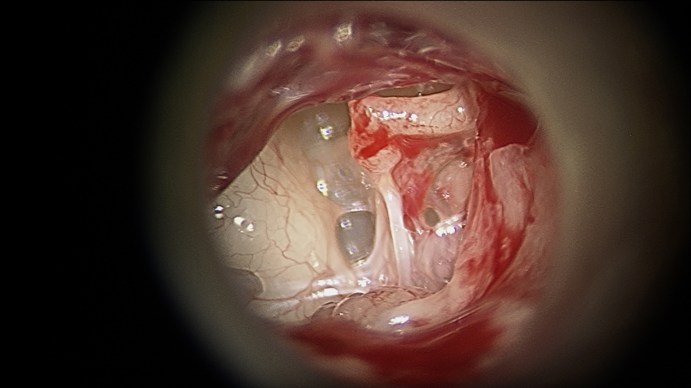
In the operating room, Dr. McElveen explained to us that the patient’s ear drum had collapsed when her Eustachian tube (a passage that permits the equalization of pressure on both sides of the ear drum) acted as a vacuum and sucked the ear drum in on itself. The collapse caused a tear in the ear drum, so the patient had a large hole in it. To correct this, Dr. McElveen cut cartilage away from the back of the patient’s ear and augmented it to her ear drum to patch up the hole.

The “middle  ear” of the patient during surgery, showing the stapes and incus bones as well as the folded-back tympanic membrane:
Surgery1

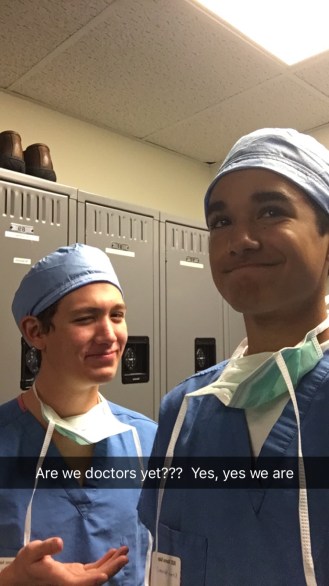
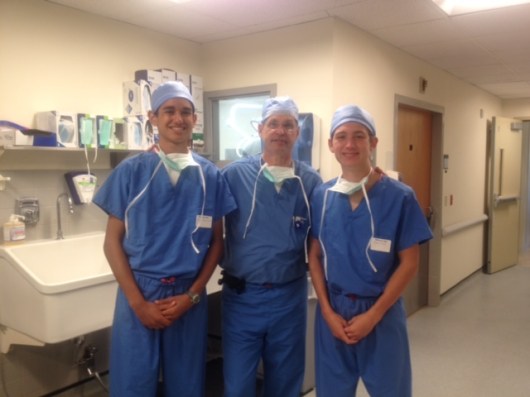
After the successful surgery ended, we celebrated with some pictures with Dr. McElveen and in our scrubs:
IMG_0929

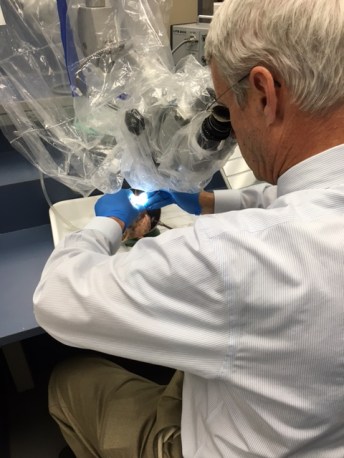
We then headed back to the Carolina Ear and Hearing Clinic where Dr. McElveen set Jonathan and me up in the clinic’s temporal bone lab. He let us probe a temporal bone and it’s ear cartilage, and it was really cool! However, we did find out how hard it is to actually be a surgeon from this because of how precise your instruments need to be held, and how hard it is to keep your hands from shaking when probing the patient’s body. The ear canal is so narrow that I felt like I was playing Operation since I wasn’t supposed to shake the probe and touch the sides of the canal!

Dr. McElveen demonstrating how to probe the temporal bone in the bone lab:
IMG_0908

Jonathan probing the temporal bone:

IMG_0909

After we (half) successfully probed the temporal bone and the ear cartilage, we had our lunch break. After lunch, Dr. McElveen had to leave to go to South Carolina to perform a surgery there. Thus, Jonathan and I separated and I went with one of the audiologists to examine a patient with a tumor on their hearing nerve called an acoustic nueroma. She conducted several tests on the patient in order to determine whether it was worth it for Dr. McElveen to attempt to save the patient’s hearing capability in the ear and remove the tumor, or if he should just incise the hearing nerve in order to remove the tumor, which would ultimately render the patient deaf in the one ear. One of the tests was to lay the patient down in a dark room and put plugs in her ears that would send sounds through her nerves and a machine would measure how long it took the brain to receive the sound. The patient had to lay completely still so that all of the body’s focus would be on delivering those sounds to her brain. Apparently she was laying so still that she actually fell asleep during the test! This was okay though according to the audiologist because the data still comes back accurately. After several tests, the audiologist determined that it would not be worth it for Dr. McElveen to attempt to save the patient’s hearing capability.

Today was such an amazing experience since we did so much observing and hands-on activities! I will never forget being in that operating room and observing the surgery; my jaw was dropped the whole time as I was in such awe of what Dr. McElveen was doing throughout the operation! It was also a very formative experience, and it definitely sparked my interest in possibly going into surgery as a career option. – Kiran W.

Perks of Interning (Day 2 @ AMM)

Today I had a later start because Dr. Lewis didn’t start seeing patients until 9:30 am (Yay! More sleep). Like yesterday, I shadowed Dr. Lewis and asked questions throughout the day. Some of the topics that came up in our conversations today were vericose veins, Parkinson’s disease, bicornuate uterus, A1C test (a blood test that gives info on blood sugar – can be used to diagnose prediabetes and diabetes). Dr. Lewis’ last patient left around 12: 30 pm so after I had lunch I met with Ms. Daniel. I spent the rest of the day helping Ms. Daniel with data entry to remind patients (by email) of when the wellness programs take place. Overall, today was an eventful day. I’m glad that I learned so much!

-Biruk

AMM pic

Day 1: Patients with Patience

Day 1 at the Carolina Ear and Hearing Clinic was already a restless one… Dr. John McElveen had over 40 patients to attend to, and we were at his side in the examination rooms the entire time! When Jonathan and I arrived to the clinic at 8:00 AM we were first suited up with lab coats so that we at least looked the part of doctors (even though we didn’t fully understand all of Dr. McElveen’s medical jargon). The morning started with a staff meeting that we sat in on where the upcoming month pertaining to all of Dr. McElveen’s surgeries was discussed (mostly at least… an engagement was also announced during the meeting which provided some well-needed excitement to wake everybody up on an early Monday!). After the meeting, Dr. McElveen had to rush to get on a conference call, so some of his nurses took Jonathan and me on a tour of the office and let us sit in on some of the hearing tests performed by the audiologists. The audiologists were very good at explaining what they were doing as they went along, and what all of their charts indicated in the patient’s file. After Dr. McElveen’s conference call had ended, he pulled us out from the hearing test rooms as it was time for him to begin examining patients. We hopped from room to room as Dr. McElveen examined the patients’ ears. Conveniently, on his magnifying device that he looked into to see the ear canal better was a camera that displayed and enlarged Dr. McElveen’s procedure on a television screen. Most of the times it was really cool to be able to see real-time footage of Dr. McElveen scanning the ear with his instruments (he was very good with pointing out certain things in the ear to explain stuff to us as he went along); however, some of the times it was kind of gross, like when he removed all of a patient’s ear wax or scraped away their dried-up ear fluid. The worst was when he used a suction tool to suck up all of the patient’s pus-like ear fluid. Jonathan and I stood there staring at the screen pretending to be professional and unfazed by the nauseating pus-fluid, but we later admitted to each other that we were both repulsed by it. After seeing all of these repulsive and gross bodily substances, it was time for our lunch break… perfect! Despite this, lunch was actually really enjoyable because we became much more acquainted with Dr. McElveen’s staff who is a really fun group of people. After our lunch break, Dr. McElveen had Jonathan and me research some common medical procedures and terms such as cochlear implants and otosclerosis. One of the nurses then explained to us how some of the advanced hearing aids worked and how to custom-program them to meet a specific patient’s needs. After this, we rejoined Dr. McElveen and continued shadowing him in the examination rooms until the office day was over at 5:00. Although Jonathan and I complained to each other throughout the day about standing up for too long without sitting (it’s actually a pretty challenging task that we are not accustomed to doing on a daily basis), we have absolutely nothing to complain about regarding our day as a whole, or the Carolina Ear and Hearing Clinic. It was truly an amazing and informative day, and we cannot wait to shadow Dr. McElveen in the operating room tomorrow during a surgical procedure! – Kiran W.

image1

Introduction to Alliance Medical Ministry

Today I met with Dr. Lewis at Alliance Medical Ministry. I had the opportunity to shadow her and meet her patients. I also met the volunteer coordinator, Ms. Daniel, who gave me a tour of Alliance and talked to me about the facility. This clinic is a nonprofit clinic that is funded by donations. These donations allow working uninsured adults in Wake County to get healthcare. AMM focuses on treating “the whole person” (a phrase used multiple times today). In addition to primary care, the clinic provides counseling and wellness programs (yoga, cooking classes, etc.). Everyone I met at AMM was very kind and welcoming. I can’t wait to go back tomorrow!

-Biruk

size_550x415_new20bldg20front201a