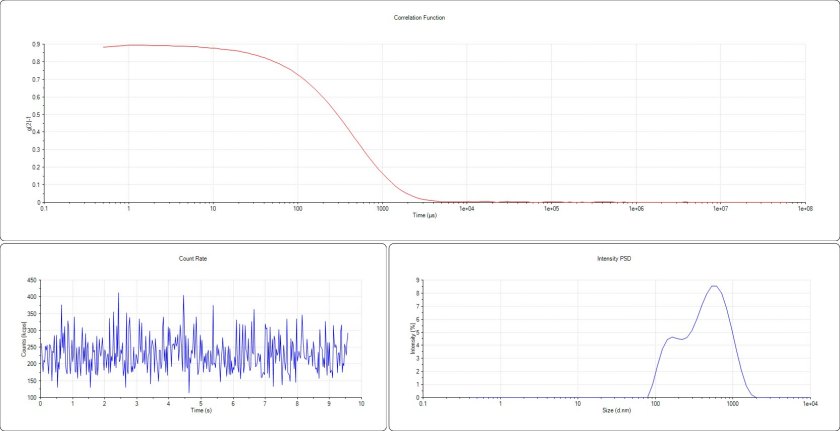
Light Diffraction Data from a sample – for tips on what this means please browse the links below…
FAQ – ELS Overview An_Introduction_to_DLS in 30 Minutes
There is never a shortage of things to do at RTI! Though the day started a little slow with some light reading (by the way the Tale of the Dueling Neurosurgeons by Sam Kean is a great read), once it started moving it never quite stopped. We continued some lab work from yesterday. First we ran samples (made from surfacant, chromium, and polymer) through a sonicator. A sonicator uses audio submerged in water to break up aggravated particles. Then we used a centrifuge to separate particles to the bottom. Next, came the fun part of syringing the solution into a curved cell to be put into a dynamic light scattering machine (or DLS). Surfacants are bipolar substances, which kinda look like tadpoles under a microscope, with a hydrophobic and hydrophilic end. Sometimes surfactants aggregate and form micelles, which are simply aggravated surfacant molecules in a colloid (a colloid is a mixture with insoluble substance microscopically dispersed). These micelles are spherical in shape with the hydrophobic tails facing towards the center. This brings us to the CMC (critical micelle concentration), which is the concentration of surfacants above which micelles form and all additional sufucants form micelles. THis is relevant information because when running the samples through the DLS the graphs will be erratic if the pH induced the formation of micelles and the size vary greatly. The purpose of an DLS machine is to track nano particles and the relative size of particles. One we reached lunch I got to sit in on the YP lunch presentations (that’s young professionals – man these people like their acronyms!). The presentations serve to bring people at RTI together to practice presenting their findings to a group in part to share their findings with other departments and to also give those with less established careers to have the experience of presenting. I heard a lecture on mapping the innovation process and the iterative cycles of learning and focus, fluorescent carbon nano particles found in coffee and fruit juices (presented by the one and only Phil Durham), and idea generation in relation to energy technology development. We then spent the remainder of the day continuing the study and learning about polymers. Yay!
 CA Work Experience Program 2016